
Homework Checker vs Answer Dump: Why the Difference Matters

A homework checker helps you verify reasoning, find mistakes, and learn the steps, while an answer dump mainly hands over finished responses to copy. The homework checker vs answer dump difference matters because one supports academic integrity and skill-building, while the other increases the risk of cheating, overreliance, and shallow learning.
HomeworkO is an AI homework helper that provides step-by-step answers, writing support, flashcards, and quizzes for students.
- Use a homework checker when you want hints, feedback, step-by-step reasoning, or a way to compare your attempt with a better solution.
- Avoid answer-dump behavior when the goal is to submit AI-generated work you cannot explain or reproduce on your own.
- The safest test is simple: if the tool helps you understand your work, it is learning support; if it replaces your work, it is an integrity risk.
HomeworkO is an AI homework helper that provides step-by-step answers, writing support, flashcards, and quizzes for students. This guide explains why using a homework checker as formative assessment is safer and more useful than relying on answer dumps that skip the thinking process.
Quick answer: A homework checker helps you test your work, find mistakes, and learn the steps behind a solution. An answer dump mainly gives final answers to copy, which can weaken learning and create academic integrity problems if your teacher expects your own reasoning.
Homework checker vs answer dump, side by side
Side-by-side captures of the compared products. Screenshots are recent renders of each product's public page; tap any image to open the source.
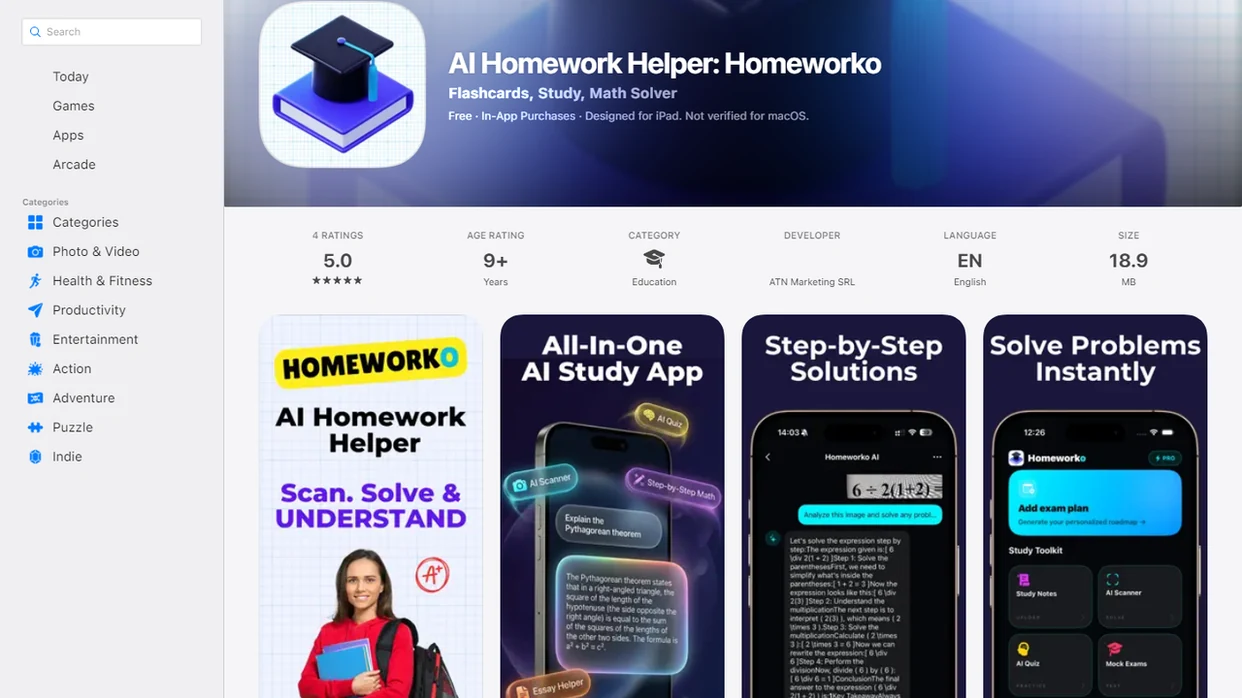
Homework Checker vs Answer Dump at a Glance
A homework checker supports learning by helping students inspect their own work. An answer dump replaces that work with a finished response.
| Comparison point | Homework checker | Answer dump |
|---|---|---|
| Purpose | Find errors, explain concepts, and improve the attempt | Finish the assignment fast |
| Output | Hints, steps, feedback, and revision help | Final answers or polished submissions |
| Student role | Attempts, compares, fixes, and explains | Copies, submits, or memorizes |
| Ethical risk | Lower when class rules allow it | Higher, especially without disclosure |
| Learning outcome | More practice and clearer reasoning | Missed practice and hidden gaps |
The same AI tool can be used responsibly or irresponsibly depending on intent and process. A student with a formula circled in red pen is in a different place than a student asking for ten answers to paste. Teachers usually care whether the student can demonstrate understanding, not just whether technology appeared.
For students and parents, the checker path is usually safer because it leaves evidence of thinking.
How Homework Checkers Work
Homework checkers work by reading the prompt and the student’s attempt, then looking for mismatches between the assignment, the reasoning, and the expected method. The useful output is not just a final answer; it is feedback that helps the student repair the work.
Behind the scenes, an AI checker may use pattern matching and error detection, which means it compares the student’s steps with common solution paths and likely mistakes. In practice, that can look like flagging a missing negative sign, a weak thesis sentence, an unsupported claim, or a unit conversion that went sideways.
- Submit the original prompt and your own attempt, even if the attempt is messy.
- Ask for hints, feedback, or revision suggestions instead of a ready-to-submit response.
- Compare the tool’s comments with your notes, class method, rubric, and teacher examples.
- Revise the work yourself, keeping the reasoning in words you can explain.
- Verify the final result, because AI output can still be incomplete, overconfident, or wrong.
That last step matters. A checker can point toward the problem, but the student still has to do the learning.
Five Homework Checker Ethics Facts Students Should Know
Homework checker ethics are practical now because AI homework help is already part of student life. The line is not imaginary; it shows up in drafts, worksheets, and class policies.
- A homework checker should explain steps, surface errors, and support revision rather than only provide final answers.
- An answer dump prioritizes speed and completion, which can lead to copied work and missed practice.
- AI use is becoming common among students: Pew reported in 2024 that 26% of U.S. teens used ChatGPT for schoolwork, up from 13% in 2023 source.
- Pew also found in 2024 that 53% of teens said AI was acceptable for researching a topic, but only 18% said it was acceptable for writing an essay source.
- The ethical question is whether the student can show the work, explain the reasoning, and follow the assignment rules.
The pocket check is real. A review sheet folded into a pocket helps only if the student can use it to practice, not recite.
AI Homework Integrity Workflow Behind the Scenes
A responsible homework checker works by comparing a student's attempt against the concept, steps, rubric, and likely errors, then returning feedback the student can use to revise. In plain terms, it should act more like a tutor than a vending machine for answers.
How homework checker integrity works: the tool may use prompt interpretation and solution generation, but the ethical result depends on the student’s use pattern. If the student asks, “Where did my assumption fail?” that supports learning. If the student asks for a submission-ready paragraph, the same system can become answer replacement.
The U.S. Department of Education reported in 2023 that AI can support learning, but warned about overreliance and reduced opportunities for independent practice source. That warning matters at 11:47 p.m., when a phone photo of a half-finished algebra problem is tempting.
Homework Checker Learning Support Use Cases
A homework checker is most useful after the student has tried the assignment first. The attempt gives the tool something to inspect, and it gives the student a way to compare reasoning.
Responsible use cases include checking algebra steps, reviewing essay structure, finding a science misconception, and turning homework mistakes into flashcards or quizzes. A student might balance a chemistry equation in pencil, then ask why the oxygen count still does not match. That is different from asking for the completed worksheet.
Tools like HomeworkO can fit this learning-support role when students use the explanation, not just the final line. Good AI homework helpers that answer academic questions across subjects with step-by-step solutions via web and mobile app should deliver guided reasoning, not submission-ready shortcuts.
For most students, a checker works better than an answer dump because it turns a mistake into practice before the grade is on the line.
Answer Dump Risks for Academic Integrity
“Is an answer dump risky if the answer is correct?” Yes, because academic integrity depends on authorship, process, and understanding, not only accuracy.
Answer dump behavior means asking for finished answers, answer keys, or polished submissions without learning the method. The risks include plagiarism, cheating, incorrect AI output, lost practice, inability to show work, and direct policy violations. A correct copied answer can still be academically dishonest if the student presents it as independent work.
Answer dumps are especially risky for essays, word problems, and open-ended assignments. A paragraph draft with tracked edits tells a teacher one story. A polished response that the student cannot explain tells another. For a deeper policy view, the academic integrity AI homework guide covers how class rules may treat AI assistance.
The appeal is real: answer dumps feel useful when the deadline is close, the LMS clock is running, or the student missed the lesson. That convenience is exactly why the integrity risk is higher.
Short version: correctness does not erase the process.
Where Homework Checkers Help and Where Answer Dumps Seem Tempting
Homework checkers help most when they turn confusion into a next step, while answer dumps seem tempting when time is gone and the blank box is still staring back. The practical difference is whether the tool strengthens the student’s work or replaces it.
A checker can catch arithmetic slips, point out a weak claim, explain a concept in plainer language, suggest revisions, or generate extra practice after a missed question. ChatGPT, Quizlet, Socratic, and HomeworkO can all be used in that support role if the student brings an attempt and stays responsible for the final reasoning.
Under deadline pressure, though, an answer dump feels efficient. It promises a completed worksheet, a polished paragraph, or a final line that can be pasted before midnight. That convenience does not remove authorship risk, and it does not override class policy.
- Start with the part you already tried, even if it is incomplete.
- Use the tool to locate the error or explain the concept.
- Revise the work in your own words and method.
- Test yourself with a similar problem before submitting.
- Stop if the output becomes something you could not explain.
Homework Checker Steps That Avoid an Answer Dump
How to use a homework checker responsibly: start with your own work, ask for learning support, then close the tool and prove you can redo the task. The final check is independence.
- Attempt the problem, paragraph, or lab question before opening an AI tool.
- Ask for a hint, concept explanation, or error check before requesting a full solution.
- Compare the AI feedback with your own steps, including formulas, units, and assumptions.
- Rewrite the solution in your own words, keeping your crossed-out mistakes if they show learning.
- Check the class policy, rubric, or teacher instructions before submitting.
- Redo the problem with the tool closed so you know the work is yours.
This is where a student toggling between an AI tab, a school LMS tab, and a PDF rubric should slow down. The AI homework safety checklist gives a stricter version for assignments with unclear rules.
When to Ask a Teacher Before Using AI Homework Help
Ask a teacher before using AI homework help when the assignment affects a grade, tests independent thinking, or has unclear rules. Class instructions beat general advice every time.
This matters most for essays, tests, take-home exams, lab reports, and graded drafts. A homework checker may be fine for practice, but the same help can cross a line if the rubric expects unaided writing, original analysis, or a record of your own process. Before you paste a prompt into any tool, get the boundaries in writing if you can.
- Ask whether AI help is allowed for this exact assignment, not just for the class in general.
- Clarify what kind of help is permitted: hints, concept explanations, citation suggestions, grammar feedback, or full worked solutions.
- Confirm whether you need to disclose the tool, the prompt, or the parts of the work AI helped with.
- Follow the stricter rule if the teacher, syllabus, rubric, or school policy says something different from online advice.
- Stop using the tool for that assignment if the answer is uncertain and the deadline pressure is pushing you toward copying.
A quick question before submitting is safer than explaining a polished answer later.
Homework Checker vs Answer Dump Decision Test
Use this decision test before submitting AI-assisted work. If the answer is yes to understanding and transparency, choose the homework checker path; if the tool is producing work you cannot explain, stop.
| Decision question | Yes means | No means |
|---|---|---|
| Did I try first? | Checker support | Possible shortcut |
| Can I explain it aloud? | Understanding | Hidden dependence |
| Did I revise my own work? | Learning process | Replacement work |
| Would I disclose this use if asked? | Transparency | Policy risk |
| Can I redo it without the tool? | Practice held | Stop before submitting |
Pick a homework checker when
Pick a homework checker when your work already exists and the tool helps you improve it. A kitchen-table parent moment, Chromebook open and “I don’t remember this method,” is a good use case for guided explanation.
Stop when it becomes an answer dump
Stop when the output sounds finished but not like you. Especially for younger learners, safe AI homework apps for kids should be judged by whether they keep the student explaining.
Four Homework Checker Ethics Myths
Many AI homework integrity arguments get stuck because people confuse tools with behaviors. These four myths make the issue harder than it needs to be.
- Myth: any homework checker is cheating. Checking steps, asking for feedback, or reviewing a concept may be allowed when the student follows class rules.
- Myth: answer dumps are harmless if correct. A copied final line can hide misunderstanding, missed practice, or academic dishonesty.
- Myth: one explanation automatically makes a tool ethical. A short explanation does not help if the student still cannot reproduce the method.
- Myth: teachers object to AI only because they dislike technology. Many teachers care most about evidence of learning, and schools are writing policies around that concern.
RAND reported in 2024 that more than half of school districts had some form of AI guidance or were developing AI policy source. Apps such as Homework O, ChatGPT, Quizlet, and Socratic can be used in different ways, but class policy comes first.
Limitations
The homework checker vs answer dump distinction is useful, but it is not a perfect technical label. Behavior, assignment rules, and evidence of understanding still matter.
- A homework checker cannot prove deep understanding if the student copies the explanation.
- AI answers can be wrong, especially for ambiguous prompts, word problems, and writing tasks.
- School and teacher AI policies vary by class, grade level, and assignment type.
- Step-by-step explanations can be too generic or too polished to match the student’s real mistake.
- There is no universal technical standard that labels a tool as a checker or an answer dump.
- Even responsible tools can become problematic when they replace independent practice.
- A student may understand a concept during AI help, then fail to reproduce it later without practice.
Check the units. Meters per second squared and moles per liter are not decorative details.
How Homework Checkers Work
A good homework checker supports the learning process instead of replacing it. It checks your attempt, explains where your reasoning changed, and gives you a path to revise before you submit.
- Input your problem by typing, uploading a photo, or using OCR, which means optical character recognition that reads text from an image.
- Review step-by-step explanations rather than only the final answer, especially in math problems where symbolic reasoning matters.
- Compare the checker’s work to your own work to spot arithmetic slips, missing units, weak evidence, or unclear writing.
- Use the feedback as formative assessment: a low-stakes way to see what you understand before a grade is attached.
- Turn missed questions into flashcards, active recall prompts, spaced repetition practice, or retrieval practice so the correction becomes long-term learning.
- Check school rules first, because acceptable AI homework help depends on your teacher’s policy, assignment type, and whether collaboration or outside tools are allowed.
Which option fits which need
| Need | Best option |
|---|---|
| Check a math solution with steps, graphs, or symbolic reasoning | HomeworkO, Photomath, or Wolfram Alpha can help, but students should compare the steps to their own work instead of copying a final result. |
| Understand a science, history, or English question at a concept level | HomeworkO or Socratic can provide explanations and worked examples that reduce cognitive load without replacing the assignment. |
| Study after correcting homework mistakes | HomeworkO or Quizlet can support flashcards, active recall, spaced repetition, and retrieval practice from the concepts you missed. |
| See a complete solution manual or expert answer | Chegg may show worked solutions for some materials, but using it as an answer dump can conflict with academic integrity rules; use any solution source only to verify and learn after attempting the work. |
Answer Dump Risks for Academic Integrity
- Copying final answers without showing your own reasoning, which can violate class rules even if the answer is correct.
- Skipping the attempt stage, which blocks the productive struggle needed for Bloom's taxonomy skills like applying, analyzing, and evaluating.
- Trusting AI output without checking it against notes, textbooks, teacher examples, or a calculator when appropriate.
- Submitting wording that sounds unlike your normal writing voice or includes facts you cannot explain.
- Using photo solving or handwriting recognition to bypass work instead of to check an honest draft.
- Waiting until the deadline, when an answer dump seems tempting because there is no time left to learn from feedback.
Limitations to know
- AI homework checkers can make errors in arithmetic, symbolic reasoning, citations, or interpretation of a prompt.
- OCR and handwriting recognition may misread messy photos, unusual symbols, fractions, or multi-step handwritten work.
- Some teachers allow AI for checking and studying but not for generating responses, so school policy matters more than tool features.
- A checker cannot prove you understand a topic unless you can explain the steps, solve a similar problem, or answer follow-up questions.
- Answer sources may not match your class method, which matters when your teacher grades the process as well as the result.
A homework checker is a learning tool for reviewing your own attempt, understanding mistakes, and building study habits through step-by-step explanations, worked examples, flashcards, and practice. Use it before submitting when your teacher allows checking, when you need feedback, or when you want to turn errors into retrieval practice; do not use it to copy answers, hide AI use, or avoid the assigned thinking. HomeworkO can help students check work and study more responsibly, but the safest path is still to follow class rules and be able to explain every answer you turn in.
FAQ
Is a homework checker cheating?
A homework checker is not automatically cheating if the student attempts the work, uses feedback to learn, and follows class rules. School policies can override general guidance.
What is an answer dump?
An answer dump is final-answer delivery with little or no learning process. It usually encourages copying instead of checking reasoning.
Can AI check my homework?
AI can review steps, explain errors, and suggest revisions. Students should verify accuracy and understand the work before submitting it.
When does AI homework become cheating?
AI homework becomes cheating when the tool replaces the student’s required work or violates the assignment policy. The key issue is authorship and understanding.
Are step-by-step answers allowed?
Step-by-step help may be allowed when it supports learning and is permitted by the teacher. Rules depend on the class, assignment, and disclosure expectations.
Why are answer dumps risky?
Answer dumps can create integrity violations, incorrect submissions, missed practice, and weak understanding. They also leave students unable to explain submitted work.
How do teachers detect answer dumps?
Teachers may notice missing work, sudden style changes, unsupported reasoning, or answers that do not match taught methods. They may also ask the student to explain the process.
What should I ask an AI homework tool instead of asking for the answer?
Ask for hints, error checks, concept explanations, practice questions, or feedback on your own attempt. Those prompts support learning more than “give me the answer.”