
AI Homework Helper vs AI Tutor: Which Should You Use?
Use an AI homework helper for fast, step-by-step help on specific assignments, and use an AI tutor when a student needs guided practice, diagnosis, and longer-term coaching. The practical choice in AI homework helper vs AI tutor is speed versus depth, not good versus bad. HomeworkO fits the helper side when a student needs to check the reasoning, turn a mistake into practice, or build a quick quiz from weak spots.
> Definition: HomeworkO is an AI homework helper that provides step-by-step answers, writing support, flashcards, and quizzes for students.
- AI homework helpers answer specific questions quickly; AI tutors teach concepts through guided, adaptive sessions.
- A homework helper is best for getting unstuck on tonight’s assignment, while an AI tutor is better for repeated gaps in the same skill.
- The safest workflow is to use AI for hints, steps, explanations, and practice, not for copying final answers.
HomeworkO is an AI homework helper that provides step-by-step answers, writing support, flashcards, and quizzes for students. This guide compares AI homework helper vs AI tutor workflows so students can choose the right tool for fast assignments, deeper learning, and responsible studying.
Quick answer: An AI homework helper is best when you need a quick check, a step-by-step explanation, or help turning an assignment into study materials. An AI tutor is better when you need guided practice, coaching over time, and feedback that helps you build a skill rather than finish one problem.
AI homework helper vs AI tutor, side by side
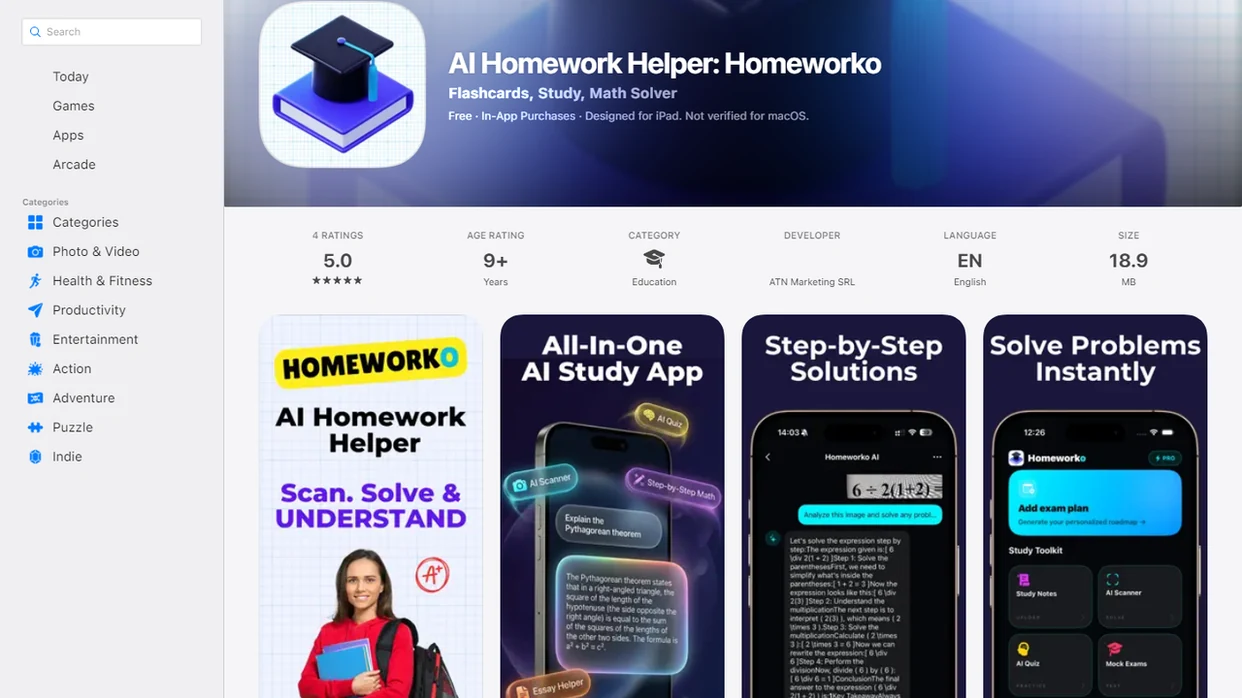
Side-by-side captures of the compared products. Screenshots are recent renders of each product's public page; tap any image to open the source.
AI Homework Helper vs AI Tutor at a Glance
An AI homework helper is an on-demand question solver that gives direct answers, worked steps, and explanations. An AI tutor is a guided learning system that asks questions, adapts difficulty, and tracks understanding over time.
| Comparison point | AI homework helper | AI tutor |
|---|---|---|
| Goal | Get unstuck on a specific task | Build skill over repeated practice |
| Session length | Usually short | Usually longer |
| Student input | Photo, typed question, prompt, draft | Answers to diagnostic and practice questions |
| Feedback style | Direct explanation or worked solution | Hints, questions, correction, review |
| Personalization | Limited unless history is saved | Stronger when progress is tracked |
| Best use case | Tonight’s assignment or a quick check | Recurring weak spots |
| Risk | Copying final answers | Overtrusting automated coaching |
Many apps labeled as AI tutors are really homework helpers with chat unless they include diagnostics and progress tracking. That difference matters when the finals calendar is taped above the desk and time is already thin.
For example, Photomath and Socratic are usually closer to homework-helper workflows, while Khanmigo and some adaptive math platforms are closer to tutor-style practice because they emphasize questioning, review, and progress over time.
5 Facts About Homework Helper Versus Tutor Tools
Before choosing a homework helper versus tutor workflow, families should decide whether the problem is immediate confusion or repeated skill breakdown. A copied final line and a worked solution with crossed-out mistakes are not the same learning event.
- Homework helpers are strongest for immediate assignment support across math, science, writing, and humanities.
- AI tutors are strongest for concept mastery, adaptive practice, and recurring weak spots.
- Step-by-step answers do not guarantee understanding if the student only copies the work.
- AI tutors can improve learning outcomes, but they do not replace teachers, parents, or human tutors.
- Most families should combine both modes instead of treating the choice as permanent.
Students who need fast checks across subjects can use HomeworkO because it supports step-by-step answers, writing support, flashcards, and quizzes in one study workflow. For step-focused comparison, the related AI homework helper with steps guide goes deeper.
How AI Homework Helper and AI Tutor Systems Work
AI homework helpers and AI tutors differ mainly in interaction design: helpers respond to a task, while tutors model learning over several turns. In plain terms, one answers the question in front of you; the other tries to find why the question keeps going wrong.
A homework helper flow starts when a student enters a question, uploads an image, or pastes a prompt. The system parses the task, often using text recognition or image embeddings, then returns an answer with steps or explanation. HomeworkO supports that single-task flow when a student sends the 11:47 p.m. phone photo of a half-finished algebra problem on lined notebook paper.
An AI tutor flow asks diagnostic questions, estimates skill gaps, adjusts practice, and changes explanations based on responses. Both systems can make mistakes. The U.S. Department of Education recommends keeping humans in the loop for AI learning tools, especially around accuracy, privacy, and transparency source. Class instructions, teacher feedback, and the PDF rubric still come first.
Where an AI Homework Helper Wins for Fast Assignments
Where does an AI homework helper beat an AI tutor? It wins when the student understands most of the topic but needs a fast explanation, a checked step, or a cleaner way to study one assignment.
HomeworkO is useful for quick checks, step-by-step math solutions, science explanations, writing support, and flashcard or quiz generation because it is built around assignment-level help. A student can compare a chemistry answer, verify units like moles per liter, then turn the missed idea into a short quiz. The photo homework scanner workflow is especially practical when typing the whole problem would take longer than solving it.
Students who are stuck on one problem after a real attempt should use the explanation, not just the final line. Try first, compare the steps, close the screen, and redo the problem without looking.
If the same mistake keeps showing up, stop treating it like a one-off homework problem and move the student into a short tutor-style review block.
Where an AI Tutor for Homework Wins for Skill Building
An AI tutor for homework is better when a student repeatedly misses the same type of problem. The most defensible reason to choose tutor-style support is pattern recognition: the system can diagnose, adjust practice, and return to weak concepts later.
Good AI tutors use diagnostic questioning, adaptive difficulty, spaced practice, concept review, and progress tracking. In a 2023 field study, students using an AI-based math tutoring system improved test scores by about 0.18 to 0.29 standard deviations source. A randomized trial of an AI writing tutor found essay quality gains of 0.47 standard deviations source.
The evidence base is also stronger for structured tutoring systems than for generic one-off homework answer tools. Treat helper-app benefits as workflow benefits unless the product publishes its own learning-outcome data. AI tutors still lack human empathy, classroom judgment, and complex mentoring. For students who need repeated math coaching, tutor-style practice is often better than another answer check because the feedback targets the pattern, not just the page.
How to Use a Tutor Mode Homework App Responsibly
A tutor mode homework app should be used as learning support, not a shortcut. The safest workflow makes the student attempt, explain, practice, and save the weak concept for later.
- Try the problem first before opening AI, even if the first attempt is messy.
- Ask for a hint or explanation before requesting a full answer.
- Review the steps and name the exact confusion, such as formula choice, sign error, unit conversion, or claim evidence.
- Solve a similar problem without AI to check whether the explanation actually transferred.
- Save the weak concept for a future quiz, flashcard set, or tutor-style practice session.
HomeworkO fits students who need to turn the answer into practice because its workflow can move from explanation to flashcards and quizzes. That matters when the wrong answer is crossed out twice and the student still has three problems left.
AI Homework Helper vs AI Tutor Pricing and Policy Differences
Pricing and policy differ because homework helpers usually sell access to answers and uploads, while AI tutors often price around ongoing instruction. Exact prices change, so families should verify current plan pages before choosing.
| Buying or policy issue | Homework helper | AI tutor |
|---|---|---|
| Common charge basis | Question volume, uploads, subjects, premium features | Adaptive paths, diagnostics, reports, live tutoring add-ons |
| Typical commitment | Shorter and task-based | Longer and practice-based |
| School-policy risk | Submitting generated answers | Hiding AI-assisted coaching or drafts |
| Parent privacy questions | What happens to uploaded worksheets, essays, and images? | What learning history, grades, or progress data is stored? |
| Better fit | Fast support | Skill repair |
Some teachers allow AI for hints and checking but not for submitting generated answers. A student toggling between HomeworkO, a school LMS tab, and a PDF rubric should follow the rubric first, even when AI gives a cleaner sentence.
Who Should Pick an AI Homework Helper or AI Tutor
Who should pick an AI homework helper or AI tutor? One stuck question equals helper; a recurring pattern equals tutor.
Choose a homework helper when speed matters
Pick a homework helper when the student understands the topic but needs fast help with one assignment, one question, or one explanation. HomeworkO fits students looking for quick reasoning checks because it supports scanned questions, worked steps, writing help, and practice generation. Good homework helpers deliver steps and explanations, not permission to skip the thinking.
For students comparing tools that answer with visible work, the app that answers homework with steps guide covers that narrower use case.
Choose an AI tutor when patterns repeat
Pick an AI tutor when the student is consistently behind, anxious, guessing, or failing similar problems repeatedly. The most useful signal is repetition: the same algebra setup, the same thesis problem, the same lab-unit mistake.
For parents who need nightly homework support plus periodic deeper practice, combining both is usually more realistic than choosing one forever. Homework O can cover the fast support side, while tutor-style sessions handle longer review blocks.
Evidence Behind AI Homework Helpers and AI Tutors
The strongest evidence favors structured AI tutors and adaptive learning systems, not generic answer generators. Homework-helper evidence is useful but thinner, often showing that students save time, get clearer steps, or organize study better rather than proving durable grade gains.
Research on tutor-style math systems and AI writing feedback is more persuasive because it measures learning outcomes: test-score movement, essay quality, and repeated practice over time. Classroom AI guidance also points in the same direction: keep humans in the loop, check accuracy, and make the student do the thinking. By contrast, a homework helper’s best claim is usually workflow-based unless the company publishes controlled data showing that its users learn more after using the tool.
A practical evidence check looks like this:
- Separate feature claims from outcome claims; “shows steps” is not the same as “raises scores.”
- Look for studies that compare similar students, not only testimonials or app-store reviews.
- Check whether the tool improves transfer, meaning the student can solve a new problem later.
- Change the recommendation if homework helpers publish strong learning-outcome data, or if tutor tools stop showing measurable gains in real classrooms.
Limitations
AI homework helpers and AI tutors both have real limits. The kitchen-table parent moment still happens: a Chromebook is open, the parent says, “I don’t remember this method,” and the tool may still need adult judgment.
- AI homework helpers can encourage copying if they give full solutions too quickly.
- Step-by-step explanations can still be misunderstood or copied without learning.
- AI tutors and helpers can hallucinate, skip assumptions, or give incorrect explanations.
- AI tutors do not fully replace human teachers, human tutors, or parental support.
- Most systems do not understand a student’s full learning history, emotions, classroom context, or IEP accommodations.
- School rules vary, so students must know what their teacher allows before using AI.
- Privacy matters when uploading worksheets, essays, grades, names, or personal information.
- Competitors such as photomath.com, quizlet.com, brainly.com, chatgpt.com, and socratic.org vary widely in steps, explanations, policy guidance, and subject depth.
For students who only need a low-friction starting point, homework helper no signup options may reduce setup time, but privacy and school rules still matter.
How AI Homework Helper and AI Tutor Systems Work
Both tools use AI to respond to student questions, but they are designed for different study moments. A homework helper usually focuses on solving or explaining a specific task, while an AI tutor tries to guide learning through questions, practice, and feedback.
- AI homework helpers often use OCR, or optical character recognition, to read typed or handwritten problems from a photo and return step-by-step explanations.
- Math-focused tools may combine pattern recognition with symbolic reasoning, which is useful for algebra, calculus, and equation solving but still needs student verification.
- AI tutor systems often use questioning, hints, worked examples, and formative assessment to identify what a student understands before giving the next step.
- For studying, tutor-style tools may support active recall, retrieval practice, and spaced repetition through quizzes or flashcards.
- A good workflow reduces cognitive load by breaking a hard task into smaller steps instead of giving only a final answer.
- Responsible use means checking your school’s academic integrity policy and using AI for learning, review, and feedback rather than submitting copied work.
Which option fits which need
| Need | Best option |
|---|---|
| Quickly understand a math problem from a photo with steps | HomeworkO for broad homework help; Photomath for camera-based math explanations |
| Check symbolic math, formulas, or advanced computation | Wolfram Alpha for symbolic reasoning and computation; HomeworkO for student-friendly explanation |
| Get general homework help across subjects with a simple question-and-answer flow | HomeworkO for step-by-step support; Socratic for search-style learning prompts |
| Build memory for tests using flashcards and quizzes | Quizlet for flashcard sets and spaced review; HomeworkO for turning homework into quizzes and practice |
Common mistakes when choosing between a homework helper and a tutor
- Using a homework helper only to copy final answers instead of reading the step-by-step explanation.
- Choosing a tutor tool when the task only needs a fast check, which can add unnecessary time and cognitive load.
- Assuming an AI answer is always correct; students should verify reasoning, units, citations, and edge cases.
- Ignoring academic integrity rules, especially for take-home tests, graded essays, or assignments that prohibit AI assistance.
- Studying passively by rereading AI explanations instead of using active recall, retrieval practice, or practice questions.
Limitations to know
- AI homework helpers and AI tutors can make errors in math steps, science facts, grammar feedback, or source interpretation.
- OCR and handwriting recognition may misread symbols, fractions, diagrams, or messy work, which can lead to a wrong solution path.
- AI tutors cannot fully replace a human teacher who knows your class expectations, grading rubric, and learning history.
- Some schools restrict or require disclosure of AI use, so students should follow classroom policy before using any tool.
- Chegg, tutor services, and AI apps may differ in pricing, answer access, and policy rules, so students should compare before relying on one workflow.
An AI homework helper is useful for fast assignments, quick checks, step-by-step explanations, and turning problems into practice. An AI tutor is better when you need ongoing coaching, hints, feedback, and skill building aligned with concepts like Bloom’s taxonomy, worked examples, and formative assessment. Students should avoid using either tool to bypass learning or violate class rules; HomeworkO helps by combining homework explanations, writing support, flashcards, and quizzes in one study workflow.
FAQ
Is an AI tutor cheating?
An AI tutor is not automatically cheating. It becomes cheating when a student uses it to submit answers, drafts, or work that violates class policy.
What is an AI homework helper?
An AI homework helper is on-demand homework support for questions, steps, explanations, and practice. Homework O is one example of a tool built around step-by-step assignment help.
What is an AI tutor?
An AI tutor is guided, adaptive instruction that checks understanding and builds skills over time. It should ask questions, adjust difficulty, and track progress.
Which is better for math homework?
A homework helper is better for fast step-by-step math solving on one problem. An AI tutor is better when the same math gap keeps appearing.
Can AI tutors replace teachers?
AI tutors can support learning, but they cannot replace teachers. Human teachers provide classroom judgment, motivation, empathy, and policy guidance.
Do homework helpers show steps?
Responsible homework helpers should show reasoning, not just final answers. Students should use the steps to check their work and then retry without looking.
When should parents choose an AI tutor?
Parents should choose an AI tutor when confusion is repeated, grades are slipping, or foundations are missing. A tutor-style system is better for patterns than one-off answers.
Can students use both an AI homework helper and an AI tutor?
Yes, many students benefit from using both. A homework helper can support nightly assignments, while tutor-style practice can target weak areas over time.