
Is There an App That Answers Homework With Steps?

Yes, an app that answers homework with steps can scan or accept a typed question, explain the reasoning, and show how to check the work instead of only giving a final answer. The safest way to use one is to attempt the problem first, compare the steps, ask follow-up questions, and follow your school’s AI policy.
> HomeworkO is an AI homework helper that provides step-by-step answers, writing support, flashcards, and quizzes for students.
- A step-by-step homework answer app should teach the method, not replace your own work.
- A safer workflow is: try first, scan or type the question, review each step, verify the answer, and rewrite in your own words when allowed.
- AI homework apps can be wrong, so students should check class rules, sources, formulas, and teacher expectations.
HomeworkO is an AI homework helper that provides step-by-step answers, writing support, flashcards, and quizzes for students. For students looking for an app that answers homework with steps, the goal should be clear explanations, error-checking, and ethical learning support rather than instant answers only.
Quick answer: Yes. An app that answers homework with steps can scan or receive a problem, explain the reasoning, and show checks so you understand how the answer was reached. The best use is not copying; it is comparing a worked example with your own attempt, finding mistakes, and practicing the skill again.
How these apps look
Side-by-side captures of the compared products. Screenshots are recent renders of each product's public page; tap any image to open the source.
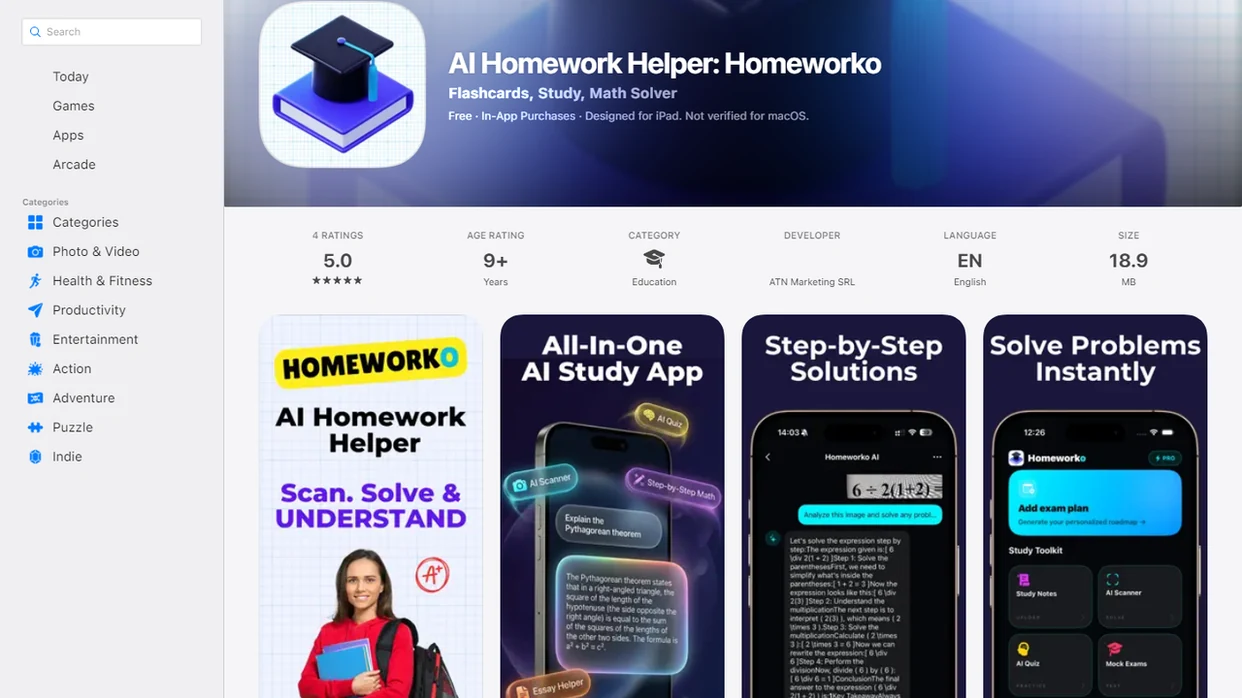
What an App That Answers Homework With Steps Actually Does
Is there an app that answers homework with steps? Yes. These apps let students type, paste, or upload a photo of a homework question, then return an explanation broken into stages.
The important split is between a final-answer app and a learning helper. A final-answer tool gives the last line. A step-by-step tool shows the method, the assumption, and often a way to check the answer. That matters when the statistics z-score table is open sideways and the formula is circled in red pen.
These tools can support math, science, history, literature, writing, and test prep, but subject quality varies. Use AI homework support as a study aid, not as proof that every generated answer is correct.
Good homework apps explain the path to an answer, not just the answer itself.
Five Facts About AI Homework Apps With Step-by-Step Answers
- These apps usually accept typed questions, pasted prompts, or photo uploads from a notebook, worksheet, PDF, or screen.
- They use AI models to identify the subject, key concepts, and likely solution path before writing the answer.
- Step-by-step explanations are most useful when compared with the student’s own attempt, including crossed-out mistakes.
- School AI policies may treat uncredited generated work as plagiarism, especially on essays, projects, or take-home assessments.
- Multi-subject homework apps can support math, science, writing, flashcards, and quizzes, but students still need to verify outputs.
Pew Research Center reported that 13% of U.S. teens said they had used ChatGPT for schoolwork, while 19% were not sure whether they had used it (https://www.pewresearch.org/short-reads/2023/11/16/about-1-in-5-us-teens-whove-heard-of-chatgpt-have-used-it-for-schoolwork/). EDUCAUSE reported in 2023 that 47% of undergraduates had used generative AI tools for coursework at least once (https://www.educause.edu/ecar/research-publications/2023/students-and-technology-report-flexibility-choice-and-equity-in-the-student-experience/artificial-intelligence).
For most students, step-by-step AI support works better after a real first attempt because the comparison exposes exactly where the reasoning broke.
How an App That Solves Homework Step by Step Works
An app that solves homework step by step converts a question into recognized text or image data, detects the subject, builds a reasoning plan, generates steps, and checks the final answer. In plain terms, the app tries to understand both what the problem says and what kind of work it requires.
Large language models predict and organize text based on patterns learned from many examples. For math, the app may also rely on symbolic reasoning, equation structure, or formula recognition. For writing, it usually looks at thesis, organization, evidence, tone, and citation needs.
Follow-up questions matter because the first explanation may not match your teacher’s method. A student toggling between an AI screen, a school LMS tab, and a PDF rubric needs a way to ask, “Why did you divide here?” Pew reported that 69% of U.S. teens who had heard of ChatGPT believed it would affect schoolwork.
Ask again when a step feels skipped. That pause is learning.
Before You Use a Homework Answer App
Before using a homework answer app, pause long enough to know what help is allowed and what you still need to do yourself. The goal is to set guardrails before a scanned worksheet or draft essay turns into something you cannot honestly explain.
- Check your teacher’s AI rules first, especially for graded essays, lab reports, projects, and take-home assessments.
- Identify the kind of support the assignment permits: tutoring-style explanation, citation formatting, brainstorming, practice problems, or full answer generation.
- Gather the materials you will use to judge the response, including class notes, rubrics, formulas, textbook examples, source requirements, and any teacher comments.
- Remove private details before uploading anything, such as your name, grades, student ID, school account information, or classroom documents not meant to be shared.
- Decide which parts you must be able to explain independently, then use the app to test that understanding instead of replacing it.
That small setup step matters when the deadline is close. It turns the app into a comparison tool, not a quiet way to bypass the assignment.
How to Use a Homework Answer App Ethically
Use a homework answer app as learning support, not a shortcut. Class policy comes first, especially when generated text may appear in graded work.
- Try the problem before opening the app, even if your first attempt is incomplete.
- Upload the question by scanning, photographing, typing, or pasting it into the tool.
- Compare each AI step against your class notes, teacher’s method, and your own work.
- Ask for clarification on any step you cannot explain out loud.
- Rewrite the final answer in your own words, and cite or disclose AI help when required.
That workflow fits the 11:47 p.m. phone photo of a half-finished algebra problem on lined paper. It does not fit copying a final paragraph into a submission box.
A good AI homework helper that answers academic questions across subjects should deliver step-by-step solutions via web and mobile app, not uncredited work to submit as your own. For a broader workflow, the AI homework helper with steps guide covers study-first use cases.
Best App Shortlist for Step-by-Step Homework Help
A useful app shortlist depends on the subject, assignment type, and school rules. Use the tool that matches the task, then check the reasoning before you trust it.
| Tool type | Best use case | Caution |
|---|---|---|
| HomeworkO | Multi-subject step-by-step learning support across math, science, writing, flashcards, and quizzes | Still requires formula, source, and policy checks |
| General AI chat tools | Explaining concepts, rephrasing confusing steps, and generating practice questions | Less homework-specific and may miss rubric details |
| Photo-scan math apps | Equation-heavy algebra, calculus, and graphing-style work | Narrower for humanities and writing assignments |
| Writing feedback tools | Draft revision, clarity checks, outlines, and grammar | Not a full reasoning tool for every homework subject |
A photo homework scanner can help when the problem is on paper and typing it would take longer than solving it. For parent-guided homework, the kitchen-table Chromebook moment often starts with, “I don’t remember this method.”
That is a support moment, not a handoff.
Common Myths About Homework Answer Apps
AI homework apps are not always correct. They can misread a problem, choose the wrong formula, skip a condition, or produce a confident explanation that does not match the assignment.
Using an AI homework app is not automatically cheating. It depends on the teacher’s instructions, the school’s policy, whether disclosure is required, and whether the student copies generated work. Reading help is different from submitting help as your own.
Another myth is that step-by-step apps only work for math. Many tools can explain science concepts, outline history responses, discuss literature passages, and give writing feedback. Still, reading worked solutions alone does not guarantee better grades. Students need active practice, self-explanation, and verification.
If sleepy eyes are rereading the same sentence, the next move is not copying. It is asking the app to explain one smaller piece.
How to Check AI Homework App Answers Before Submitting
Check AI homework answers before submitting by comparing formulas, definitions, assumptions, and final format against the assignment. Verification protects both learning and academic integrity.
For math or science, redo the final calculation independently. Check units such as meters per second squared, moles per liter, grams, or degrees. If the answer has no units but the question asks for a measured quantity, something may be missing.
For writing, compare the thesis, sources, citations, and voice against your own draft. Bibliography tabs crowding the browser are a warning sign to slow down. Make sure quoted material is attributed, and do not let the app invent sources.
If one step feels unclear, ask for the same step another way. A tool that can check homework answers is most useful when it helps you catch mistakes before your teacher does.
Limitations
AI homework apps can help, but they have real limits. Treat every answer as a draft explanation until you check it.
- AI homework apps can hallucinate confident but wrong solutions.
- They may miss teacher-specific rubrics, preferred methods, or hidden constraints.
- They can weaken independent problem-solving if used as a shortcut.
- Privacy policies may allow storage of uploaded assignments or personal data.
- Internet access, paywalls, and compatible devices may limit who can use them.
- Generated work may violate academic integrity rules if submitted without permission or disclosure.
- Photo uploads can fail when handwriting, glare, or cropped pages hide key details.
- Writing feedback may flatten a student’s voice if accepted without revision.
McKinsey estimated in 2023 that up to 30% of current work hours in education could be automated. That is context for adoption, not proof that homework answers are accurate.
If you need fast access, a homework helper no signup option can reduce friction, but it does not remove the need to check the work.
What an App That Answers Homework With Steps Actually Does
Step-by-step homework apps usually combine scanning, problem recognition, AI reasoning, and study tools. A good app should reduce confusion without doing all the thinking for you.
- Input: You type a question, upload a photo, or scan work with OCR, also called optical character recognition; some tools also use handwriting recognition for written math.
- Interpretation: The app identifies the subject, terms, equations, or prompt so it can decide whether to use symbolic reasoning, a writing explanation, or a study method.
- Worked examples: For math and science, it may break a solution into smaller steps, show formulas, and explain why each step follows from the last.
- Learning checks: Better tools encourage formative assessment by letting you compare your attempt, correct mistakes, and try a similar question.
- Study reinforcement: Flashcards, quizzes, active recall, spaced repetition, and retrieval practice help move the topic from short-term review into longer-term memory.
- Ethical use: The app should support academic integrity by helping you learn the method, not by encouraging you to submit AI-generated work as your own.
Which option fits which need
| Need | Best option |
|---|---|
| General step-by-step homework help across math, writing, flashcards, and quizzes | HomeworkO |
| Camera-based math explanations and worked examples for common school math problems | Photomath |
| Advanced symbolic reasoning, computations, graphs, and technical math queries | Wolfram Alpha |
| Quick concept explanations, textbook-style help, and study set practice | Socratic, Quizlet, or Chegg depending on the assignment type |
Common Myths About Homework Answer Apps
- Assuming every AI answer is correct. AI tools can misread a photo, skip a condition, or give a plausible but wrong explanation.
- Copying the final answer without learning the steps. This raises academic integrity concerns and usually hurts test performance.
- Skipping your own attempt. You learn more when you try first, then use the app as a worked example or error check.
- Ignoring cognitive load. If a solution shows too many jumps at once, slow down and rewrite each step in your own words.
- Using one tool for every subject. A math solver, writing helper, quiz app, and research tool may each be strong in different situations.
- Forgetting school policy. Some teachers allow AI for checking work but not for generating submitted answers.
Limitations to know
- OCR and handwriting recognition can misread symbols, fractions, exponents, or messy writing, so always check the typed version of the problem.
- AI may produce a correct-looking answer with flawed reasoning, especially for multi-step word problems, proofs, or unusual prompts.
- Writing support can help with structure and clarity, but your teacher may require your own drafting, citations, and voice.
- Apps do not replace feedback from teachers, tutoring, class notes, or official grading rubrics.
- Some assignments are designed to assess independent thinking at higher levels of Bloom's taxonomy, such as analysis and evaluation, where answer apps should be used carefully.
An app that answers homework with steps is most useful when it explains the process, helps you check your reasoning, and gives you practice after a mistake. Use it after you have tried the problem, when you need a worked example, clarification, or formative assessment; do not use it to copy answers or bypass your teacher's rules. HomeworkO supports step-by-step answers, writing help, flashcards, and quizzes so students can connect the answer to the underlying skill.
FAQ
What app answers homework with steps?
AI homework helpers like HomeworkO can provide step-by-step explanations across subjects. Students should use the steps to understand the method, not to copy unverified answers.
Can I scan homework for answers?
Yes, many homework apps let you scan or photograph a question. Review each step carefully because photo recognition can misread handwriting or cropped problems.
Is a homework answer app cheating?
It depends on your school rules, teacher instructions, disclosure requirements, and how you use the output. Using AI to learn a method is different from submitting generated work as your own.
Do AI homework apps show work?
Good tools show reasoning, intermediate steps, checks, and explanations. A final-answer-only response is less useful for learning.
Are homework apps always correct?
No. AI can hallucinate, misread questions, or choose the wrong method, so answers should be verified before submission.
Which subjects can AI solve?
AI homework apps commonly support math, science, history, literature, writing, and test prep. Subject depth varies by tool and assignment type.
Should I cite AI homework help?
Follow your school or teacher policy. If disclosure is required, cite or describe the AI assistance honestly.
Can AI explain math steps?
Yes, AI can explain math steps and show how a solution develops. Students should still check formulas, units, and the final calculation independently.