
Find Math Mistakes With AI And Learn The Fix
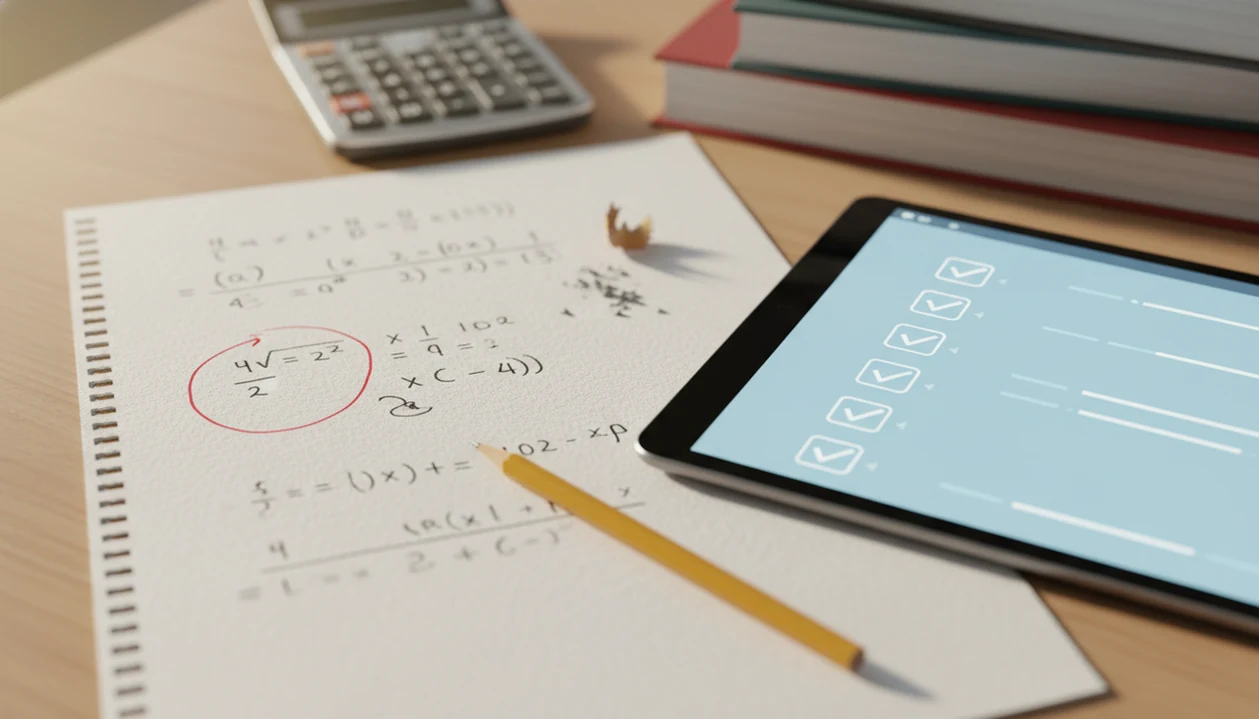
You can find math mistakes with AI by pasting your own steps, asking the tool to compare each line against the correct method, and reviewing the exact point where the reasoning breaks. The safest approach is to use AI as a step-by-step math coach, not as a final-answer machine.
Definition: Finding math mistakes with AI means using an AI homework helper to inspect your existing math work, flag incorrect steps, and explain the correction in plain language.
TL;DR - AI is most useful for locating the step where a math solution went wrong, especially in structured algebra, trigonometry, and formula-based problems. - A good math mistake checker should compare your work line by line, explain the error type, and ask you to redo the corrected step. - AI math error finders can still hallucinate, misread notation, or produce confident wrong reasoning, so students should verify important work.
HomeworkO is an AI homework helper that provides step-by-step answers, writing support, flashcards, and quizzes for students. On this page, it helps students use AI as a math mistake checker that supports learning instead of replacing their own work.
Quick answer: AI can help you find math mistakes by comparing your steps with a correct method, checking formulas, and flagging sign, unit, arithmetic, or assumption errors. The best use is not just to get the final answer, but to study where your reasoning changed so you can fix the habit.
Math Mistake Checker At A Glance
A math mistake checker is most useful when it finds the first wrong step in work you already tried. It should not replace your own setup, formula choice, or written reasoning.
The strongest use cases are signs, arithmetic slips, formulas, units, assumptions, and skipped steps. A student might paste a worked example copied line by line, then ask, “Where did my solution stop matching the correct method?” That is different from asking for the final answer first.
Small errors hide well.
Tools like HomeworkO can support guided correction when students use the explanation, not just the final line. A good AI homework helper that answers academic questions across subjects with step-by-step solutions via web and mobile app should deliver explainable learning support, not answer dumping. For graded, timed, or high-stakes work, verify AI feedback with a teacher, calculator, textbook method, or official solution.
For comparison, Photomath and Symbolab are often stronger for camera-based or equation-specific solving, WolframAlpha is stronger for exact computation, and ChatGPT-style tools are stronger for explaining written reasoning. The best choice depends on whether you need calculation, notation parsing, or a plain-language error explanation.
How AI Math Error Finders Work
An AI math error finder works by reading the original problem, parsing the student’s submitted steps, and comparing those steps with expected mathematical relationships.
In practice, the tool looks for whether each line follows from the one before it. It may compare your path with a valid solution path, then flag the first place where signs, operations, formulas, or assumptions stop matching. In algebra, that might mean noticing that subtracting 4 became adding 4. In physics, it might mean checking whether meters per second squared belongs in the final answer.
These systems use pattern prediction, symbolic cues, and sometimes calculation checks. Language models do not always calculate like a deterministic calculator. They predict likely reasoning patterns, which is helpful for explanation but risky for exactness. Handwritten fractions, crowded exponents, and multi-line formatting make the task harder, especially from a quick 11:47 p.m. phone photo of a half-finished algebra problem on lined notebook paper.
How To Use AI To Check Math Work
To check math work with AI, give the tool your original problem, your full steps, and the class method if your teacher requires one. Ask for the first wrong step before you ask for a full solution.
- Paste the original problem and every line of your work, including crossed-out steps if they show your thinking.
- Label the class method, such as factoring, completing the square, SOH-CAH-TOA, or dimensional analysis.
- Ask the AI to identify the first incorrect step and name the error type before solving the rest.
- Compare the correction with your own line, especially signs, distribution, formulas, units, and assumptions.
- Redo the corrected step independently, then finish the problem without copying the AI’s final line.
For algebra-heavy assignments, an algebra solver with steps can be useful when it keeps the work line by line. For students, first-step checking is often better than full-solution checking because it preserves the part of the problem they still need to practice.
5 Math Mistakes AI Checkers Can Find
AI checkers are strongest when the problem has a clear structure and each step can be audited. Algebra equations, trigonometry identities, and word-problem unit checks are better fits than vague prompts or messy proofs.
- Sign errors: AI can often catch when `-3x` becomes `3x`, especially in equation solving.
- Distribution errors: It may flag mistakes like turning `2(x - 5)` into `2x - 5`.
- Formula selection: It can question whether the quadratic formula, area formula, or trig identity matches the problem.
- Unit mistakes: It can notice when a rate, volume, or concentration answer has missing or mismatched units.
- Assumption errors: It may point out when a word problem assumes equal sides, constant speed, or right angles without evidence.
A math mistake checker is a reviewer, not a guarantee. The final answer still needs an independent check.
3 Student Patterns With An AI Math Error Finder
Students usually learn more when they compare their own step to the correction instead of replacing the whole solution. That comparison catches misconceptions early, before one wrong habit spreads across a full homework set.
Maya: Algebra Sign Errors
Maya keeps losing negatives when moving terms across the equals sign. The AI flags the first sign change, and she writes “inverse operation sign error” beside the line in her notebook.
Leo: Geometry Assumptions
Leo assumes two angles are equal because a diagram “looks symmetrical.” A geometry homework helper can prompt him to name the theorem, not just trust the drawing.
Priya: Word-Problem Units
Priya gets the number right but writes meters instead of meters per second. The correction makes her check whether the final answer includes units like moles per liter, square centimeters, or miles per hour.
HomeworkO fits this pattern when used as step-by-step learning support, not an answer dump. The copied final line looks neat; the worked solution with crossed-out mistakes teaches more.
Evidence On AI Math Accuracy And Learning
Research points in two directions at once: AI math reasoning is improving, but blind trust still hurts students. Specialized systems can solve hard problems, while general chatbots can fail on ordinary schoolwork.
- Chatbot algebra errors are real: The 74 reported that ChatGPT answered 25% of tested algebra problems incorrectly in 2024 coverage of chatbot math reliability source.
- Access can reduce later performance: A University of Pennsylvania study reported that students with ChatGPT access while practicing math scored about 17% lower on a later test than students without access source.
- Specialized reasoning can be much stronger: A Nature paper on AlphaGeometry reported Olympiad-level geometry performance, showing that specialized math-reasoning systems can outperform general chatbots on structured geometry tasks source.
- General tools still need checking: A fluent explanation can hide a wrong operation, skipped condition, or invalid assumption.
- Active review matters: Students benefit more when they verify the formula, units, and assumptions instead of accepting the response.
The evidence supports a simple rule: use AI feedback to study the mistake, then prove the fix yourself.
AI Math Checker Habits That Improve Learning
AI math checking improves learning when students turn the correction into practice. Start by asking for a hint or the first wrong step, not the full worked solution.
After the AI identifies an error, name it in your notebook or make a flashcard: “distribution error,” “unit conversion,” “wrong trig ratio,” or “unsupported assumption.” Then redo a similar problem without AI. That second attempt is where the method starts to stick.
One more problem. No tool open.
A calculator is still useful for arithmetic checks, and a textbook method is useful for confirming the expected format. After missed problems are marked, turn the error into a flashcard or a short quiz question. Treat step-by-step support as practice feedback, not a shortcut around showing your work.
Limitations
AI math checking has real limits, especially when the work affects a grade, placement test, scholarship, or lab result. The U.S. Department of Education warns that generative AI outputs can be inaccurate, biased, or incomplete, so human review is required in high-stakes uses source.
- AI can make basic arithmetic mistakes or explain flawed reasoning confidently.
- AI may misread notation, handwriting, fractions, exponents, or multi-line formatting.
- A correct final answer does not prove every intermediate step is valid.
- Word problems can fail when assumptions, units, or hidden constraints are misunderstood.
- Teacher-specific methods may not match the AI’s preferred solution path.
- Multi-part proofs and notation-heavy problems need extra review.
- High-stakes work should be checked against a teacher, calculator, textbook, or verified solution.
If a calculator is blinking an error message, do not let AI be the only second opinion. Slow down, re-enter the expression, and check the setup.
How AI math mistake checking works
An AI math error finder reviews the problem, your written or typed work, and the expected mathematical rules. It can use OCR, optical character recognition, handwriting recognition, symbolic reasoning, and worked examples to compare your process with a more reliable solution path.
- It reads the problem and your steps from typed input, screenshots, or photos, depending on the tool and image quality.
- It identifies the topic, such as algebra, geometry, calculus, statistics, or unit conversion, so it can apply the right formulas and rules.
- It compares your steps with a valid solution path and looks for mismatches in signs, exponents, operations, substitutions, and simplification.
- It gives step-by-step explanations that reduce cognitive load by showing one correction at a time instead of only marking an answer wrong.
- It can support formative assessment by helping you notice patterns before a quiz or test, especially when you explain the fix in your own words.
- It works best when paired with active recall, retrieval practice, and spaced repetition so you remember the correction later.
Which option fits which need
| Need | Best option |
|---|---|
| Check a full math solution and understand where a step went wrong | HomeworkO for step-by-step explanations; Photomath is also useful for camera-based equation checks |
| Verify symbolic algebra, derivatives, integrals, equations, or exact computations | Wolfram Alpha for symbolic reasoning; HomeworkO for student-friendly explanation of the steps |
| Get quick homework guidance across math and science from a photo or question | Socratic for broad question scanning; HomeworkO for guided math review and learning follow-up |
| Turn corrected mistakes into study practice before a test | HomeworkO for quizzes and review prompts; Quizlet for flashcards and spaced repetition; Chegg may help with textbook-style solution support when allowed by school policy |
5 math mistakes AI checkers can help find
- Sign errors, such as changing -3x to 3x or dropping a negative during distribution.
- Formula errors, such as using area when the problem asks for volume or mixing up slope and distance formulas.
- Arithmetic slips, including incorrect multiplication, fraction simplification, decimal movement, or exponent rules.
- Unit and label mistakes, such as adding unlike units, forgetting square units, or not converting feet to inches.
- Assumption errors, such as solving for the wrong variable, ignoring restrictions, or applying a theorem when its conditions are not met.
- Skipped reasoning, where the final answer is correct by chance but the written work does not justify the result under a teacher’s rubric.
Limitations to know
- AI math checkers can be wrong, especially with messy handwriting, unclear photos, multi-part word problems, or unusual teacher-specific methods.
- OCR and handwriting recognition may misread symbols like 1 and l, 0 and O, minus signs, exponents, radicals, or fraction bars.
- Some tools may give a correct answer but use a method your class has not learned yet, which can hurt understanding or violate assignment directions.
- AI should not be used to submit work you do not understand; follow your school’s academic integrity policy and your teacher’s rules.
- A checker can identify many errors, but you still need to practice the corrected skill through retrieval practice and new problems.
An AI math mistake checker is a study tool for comparing your work, finding errors, and learning the fix through step-by-step explanations. Use it after you try the problem yourself, during homework review, or as formative assessment before a quiz; do not use it to bypass practice, ignore teacher instructions, or submit unexplained answers. HomeworkO helps by turning math corrections into understandable steps, review questions, flashcards, and quizzes so mistakes become study material instead of just lost points.
FAQ
Can AI find math mistakes?
AI can often find math mistakes when you provide the original problem and your full steps. It should be treated as feedback to verify, not as final authority.
Is there an app that can find mistakes in my math work?
Yes, homework helper apps can check steps, flag likely errors, and explain corrections. Apps such as HomeworkO are most useful when students compare the feedback with their own work.
How do I use AI to check my math work?
Submit the problem, include all steps, and ask for the first wrong step before requesting a full solution. Then verify the correction with a calculator, textbook method, or teacher guidance.
Why does AI get math wrong?
AI can misread notation, handle arithmetic weakly, or respond to ambiguous prompts with confident but flawed reasoning. Handwriting and dense formatting increase the risk.
Can AI check algebra steps?
Yes, algebra is one of the stronger use cases when the work is clearly formatted. Line-by-line equations make errors easier to compare.
Can AI check word problems?
AI can help check word problems, but they are riskier because assumptions and units matter. Always confirm what the problem is asking before trusting the answer.
Is AI better than a calculator for checking math?
A calculator is better for exact computation. AI is better for explaining steps, identifying error types, and reviewing reasoning.
Should I trust AI math answers?
You should treat AI math answers as study feedback, not final proof. Verify important answers with another method before submitting.