
Geometry Homework Helper For Proofs, Shapes, And Diagrams
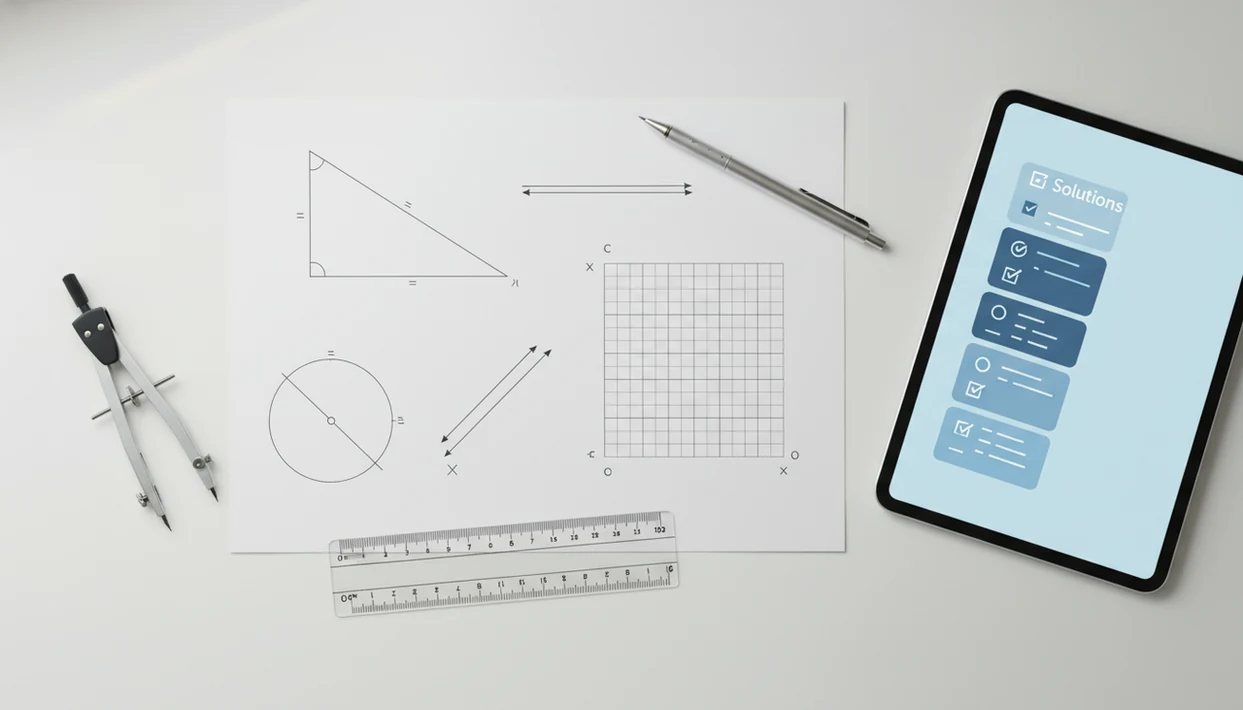
A geometry homework helper should explain the diagram, name the theorem or formula used, and show each proof or measurement step so you can verify the reasoning instead of copying an answer. The strongest support handles typed questions, photos, labels, assumptions, and class-style proof formats.
> A geometry homework helper is an online tool, app, or AI tutor that gives step-by-step support for geometry problems involving shapes, diagrams, measurements, formulas, and proofs.
- Use an AI geometry solver for step-by-step reasoning, not just final measurements.
- Check every diagram label, given condition, theorem, and formula before trusting the result.
- For proofs, ask for a statement-reason structure that matches your teacher’s format.
HomeworkO is an AI homework helper that provides step-by-step answers, writing support, flashcards, and quizzes for students. For geometry, it can help students interpret diagrams, organize proof logic, review formulas, and practice the reasoning behind visual and symbolic steps.
Quick answer: A geometry homework helper can support proofs, shapes, diagrams, formulas, and coordinate geometry by breaking a problem into visible steps. Students should use it to check assumptions, verify measurements, and understand why each statement follows, not just to copy a final answer.
Geometry Homework Helper Definition For Proofs And Diagrams
A geometry homework helper is an online tool, app, or AI tutor that gives step-by-step support for geometry problems involving shapes, diagrams, measurements, formulas, and proofs.
Geometry needs more than a calculator because the picture matters. Triangles, circles, angles, coordinate geometry, similarity, congruence, proofs, and diagrams all depend on relationships that must be stated or marked. A right-angle box changes the solution. So does a pair of parallel arrows.
A useful helper connects visual information to logical steps. It should explain why two triangles are congruent, why an angle sum applies, or why a coordinate formula fits the problem. HomeworkO is an AI homework helper that provides step-by-step answers, writing support, flashcards, and quizzes for students.
The point is learning support, not a shortcut.
Five Geometry Homework Helper Facts Students Should Know
- A strong geometry homework helper should accept typed questions, photo upload, and file upload, because geometry problems often come from worksheets, textbooks, LMS pages, or hand-drawn notes.
- Step-by-step solutions should reference formulas and theorems, not just say “x = 42.” For geometry, the reason is often worth as much as the number.
- Diagram-based solving should cover angle chasing, triangle congruence, similarity, circles, and coordinate geometry. A blurry screenshot of a triangle is a different task from a typed area formula.
- Students should compare AI steps with class methods. According to the 2015 NAEP High School Transcript Study (NCES: https://nces.ed.gov/nationsreportcard/hsts/), 76% of U.S. high school graduates had at least one full year of geometry credit, so teacher expectations vary widely.
- Responsible use means learning and checking, not submitting copied answers. In the 2019 NAEP mathematics assessment (Nation's Report Card: https://www.nationsreportcard.gov/mathematics/nation/achievement/?grade=8), only 40% of U.S. 8th-grade students scored at or above NAEP Proficient in mathematics, which makes step-by-step practice more useful than answer hunting.
How An AI Geometry Solver Reads Shapes And Measurements
An AI geometry solver works by reading problem text, diagram labels, known values, and visual relationships, then mapping them to formulas, theorem conditions, and proof rules. In plain terms, it tries to turn a picture into usable math.
Image interpretation may identify labels like AB, angle C, radius r, or a marked pair of congruent sides. Text parsing then reads givens such as “AB is parallel to CD” or “triangle ABC is similar to triangle DEF.” The solver compares those details with rules for angle sums, similarity ratios, circle theorems, and coordinate formulas.
Here is the catch: a diagram is not automatically to scale unless the problem says so. Ambiguous sketches and missing assumptions can change the answer. That’s why the AP review packet full of tabs still matters; your class notes may show the exact theorem your teacher expects.
A geometry helper usually works best when the diagram labels are clear and the student verifies every assumption before accepting the solution.
Geometry Diagram Solver Requirements Before You Start
“What do I need before using a geometry diagram solver?” You need a clear image, the full problem text, and a careful list of what is given versus what only looks true.
Use a photo where labels, angle marks, tick marks, and units are visible. List all givens from the text before solving. Then identify what the problem asks for: measure, length, area, proof, equation, or construction. Do not assume parallel lines, congruent sides, right angles, or equal arcs unless they are marked or stated.
Tiny markings matter.
School policy also comes first. A nationwide NCES survey found that 58% of 9th–12th graders reported getting homework help from a computer at least once or twice a week (NCES: https://nces.ed.gov/programs/digest/), but digital help still has to match classroom rules. Good AI homework tools that answer academic questions across subjects deliver step-by-step solutions via web and mobile app, not permission to bypass the work.
How To Use A Geometry Homework Helper Step By Step
Use a geometry homework helper as a checking and explanation tool, not as the first move. The student who tries the problem first usually asks better questions.
For HomeworkO, include both the image and the typed problem text when you can. That reduces the chance that a faint angle mark, subscript, or unit label gets guessed from the photo alone.
- Try the problem yourself first, even if you only write the givens and one possible theorem.
- Upload or Enter the problem as a clear photo, typed prompt, or file, including every label and unit.
- Mark the givens, unknowns, and assumptions, especially parallel lines, congruent parts, right angles, and scale.
- Review the theorem, formula, and proof step before trusting the arithmetic or final statement.
- Practice a similar problem without looking, then compare your work with the explanation.
Tools like HomeworkO can provide step-by-step support across subjects without treating homework like an answer dump. That matters when a geometry question turns into algebra, or when the next assignment needs written reasoning. For equation-heavy side work, an algebra solver with steps can help you check the manipulation separately.
If you compare HomeworkO with tools such as Photomath, Mathway, Symbolab, or ChatGPT, check whether each one names the same theorem and uses the same diagram assumptions, not just whether the final number matches.
Geometry Proof Help For Statement-Reason Tables
“How do I get help with a geometry proof?” Start by giving the helper the givens, the goal, the diagram markings, and the theorem names your class has used.
Proofs are not just answers. A statement-reason table needs each claim paired with a valid reason, such as given, vertical angles theorem, alternate interior angles theorem, SSS, SAS, ASA, AAS, HL, CPCTC, or a circle theorem. Paragraph proofs explain the same logic in sentences. Flow proofs show the chain visually.
Common proof categories include congruent triangles, similar triangles, parallel lines, circles, and quadrilaterals. The harder part is often choosing the bridge step. Maybe you need to prove triangles congruent before proving segments equal. Maybe a circle theorem unlocks an angle.
AI may use a valid method that differs from your teacher’s expected method. Adapt the proof into the required class format before submitting it, especially if your rubric asks for specific reasons.
Geometry Formula Verification For Areas, Angles, And Coordinates
Check the formula choice before checking the arithmetic. A correct calculation with the wrong formula is still wrong.
For measurement problems, verify area, perimeter, volume, angle sums, slope, distance, midpoint, and circle formulas. Ask why the formula applies, not only what formula was used. Is the triangle right? Is the radius given, or is that number the diameter? Are coordinates being subtracted in the correct order?
Units are a common giveaway. Area needs square units, volume needs cubic units, and rates or coordinate contexts may need labels like meters per second squared or moles per liter in cross-subject problems. Watch rounding, exact radicals, pi notation, and negative signs.
The safest check is boring but effective: compare the AI steps against your notes, textbook examples, or teacher’s method. For data-heavy geometry extensions, a statistics homework helper can support probability or measurement interpretation.
Common AI Geometry Solver Mistakes In Diagrams And Proofs
AI geometry solvers can make useful suggestions, but diagram and proof errors are easy to miss if you only read the final line. The copied final line looks clean. The worked solution with crossed-out mistakes teaches more.
Common mistakes include misread labels in blurry or handwritten diagrams, especially when B and 8 look similar. Some tools assume a figure is drawn to scale, even when the problem never says that. Others invent parallel, perpendicular, congruent, or tangent relationships because the sketch “looks” that way.
Proof errors can be quieter. A solver may use the wrong theorem for the given conditions, skip reasons, or write reasons too vague for class credit. “Angles are equal” is not enough if the teacher expects “alternate interior angles are congruent because lines l and m are parallel.”
Sometimes the math is right, but the format is wrong. That can still lose points.
Limitations
Geometry homework helper tools are useful, but they are not final authorities. Treat every output as a draft solution that needs checking.
- AI can misinterpret blurry text, messy sketches, faint angle marks, and missing labels.
- Advanced proofs and contest geometry may require creative constructions beyond typical AI help.
- A tool may not match your teacher’s required proof format, theorem list, or curriculum sequence.
- Over-reliance can weaken independent problem-solving if you skip your own first attempt.
- School policies on AI help, privacy, and homework submission vary by class and district.
- Diagrams are not automatically to scale unless the problem explicitly states that they are.
- Final answers should be checked against each step, not trusted automatically.
- File uploads and photos may include names, grades, or school details, so remove private information when possible.
Use the explanation, not just the final line. If the solver cannot justify a step, ask your teacher or rewrite the problem with clearer givens.
How an AI geometry helper works with proofs, shapes, and diagrams
Geometry problems often combine visual information with symbolic reasoning. A good helper reduces cognitive load by separating what is given, what must be proved or found, and which theorem or formula applies.
- Reads the problem statement and, when available, uses OCR or optical character recognition to identify labels, angle measures, side lengths, and handwritten work.
- Lists the known facts from the diagram, such as parallel lines, congruent marks, right angles, coordinates, or equal side lengths.
- Connects each step to a geometry reason, such as the triangle sum theorem, vertical angles theorem, Pythagorean theorem, similarity, congruence, or circle theorems.
- Shows worked examples and step-by-step explanations so students can compare their reasoning against a complete solution.
- Supports formative assessment by helping students find where their proof, formula setup, or diagram interpretation went off track.
- Can be paired with flashcards, active recall, spaced repetition, and retrieval practice to memorize definitions, postulates, and theorem conditions.
Which option fits which need
| Need | Best option |
|---|---|
| Step-by-step help with geometry proofs, diagrams, formulas, and study practice | HomeworkO |
| Quick camera-based support for many math problems, especially visual equation solving | Photomath |
| Symbolic reasoning, exact calculations, graphing, and coordinate geometry checks | Wolfram Alpha |
| Concept review, textbook-style explanations, and memorizing definitions or theorems | Socratic, Quizlet, or Chegg depending on the task |
Common AI geometry solver mistakes in diagrams and proofs
- Assuming a line is parallel, a triangle is isosceles, or an angle is a right angle just because it looks that way in the diagram.
- Using a formula without checking its conditions, such as applying the Pythagorean theorem to a triangle that is not confirmed to be right.
- Skipping proof reasons in a statement-reason table, which makes the argument incomplete even if the final conclusion is correct.
- Misreading OCR results from blurry screenshots, faint labels, messy handwriting recognition, or overlapping diagram marks.
- Confusing similar-looking theorems, such as ASA, AAS, SAS, SSS, and HL congruence, or using a congruence theorem when only similarity is shown.
- Copying an AI-generated answer without verifying whether each step follows the givens and matches the teacher’s required method.
Limitations to know
- AI can misinterpret diagrams, especially when measurements are not labeled or the image quality is low.
- A geometry solver may make invalid assumptions from a drawing unless the problem explicitly gives the needed facts.
- Proofs can have multiple valid paths, and an AI explanation may not match your class’s preferred theorem names or proof format.
- Some schools restrict AI use, so students should follow academic integrity rules and use help for learning, checking, and practice.
- For graded work, students should verify every statement, reason, formula substitution, and unit before submitting.
A geometry homework helper is useful for checking diagrams, building statement-reason proofs, reviewing formulas, and understanding step-by-step reasoning in shapes, angles, areas, and coordinates. Use HomeworkO when you need guided practice, worked examples, or study tools like flashcards and quizzes; do not use it as a substitute for your own reasoning or when your teacher prohibits AI assistance.
FAQ
Can AI solve geometry diagrams from a photo?
AI can help solve labeled geometry diagrams from a photo when the image is clear and the assumptions are stated. Accuracy drops when labels, marks, or units are blurry or missing.
Is using geometry proof help cheating?
Geometry proof help is not automatically cheating if you use it to understand steps, check reasoning, and practice. Submitting an AI-written proof as your own may violate class policy.
How do I check a geometry proof before submitting it?
Verify the givens, goal, diagram markings, statement-reason links, theorem names, and any hidden assumptions. Each statement should follow logically from the previous information.
Can AI read hand-drawn geometry diagrams?
AI can sometimes read hand-drawn geometry diagrams if labels and markings are clear. Messy sketches, crowded notes, or faint handwriting can lead to wrong interpretations.
Which geometry formulas should I know for homework?
Know core formulas for area, perimeter, volume, circles, angle sums, slope, distance, and midpoint. Also know when each formula applies.
Why is my AI geometry answer different from my teacher's method?
Geometry problems often have multiple valid solution paths. Your teacher may require a specific theorem, proof structure, or class method even when another method is mathematically correct.
Can AI help prove triangle congruence?
AI can help prove triangle congruence using SSS, SAS, ASA, AAS, or HL when the required givens are present. It should name the congruence rule and show how each condition is satisfied.
Should geometry diagrams be treated as drawn to scale?
Geometry diagrams should not be treated as drawn to scale unless the problem explicitly states a scale or provides measurements. Visual appearance alone is not proof.