
See Study Progress From Homework, Notes, and Quizzes
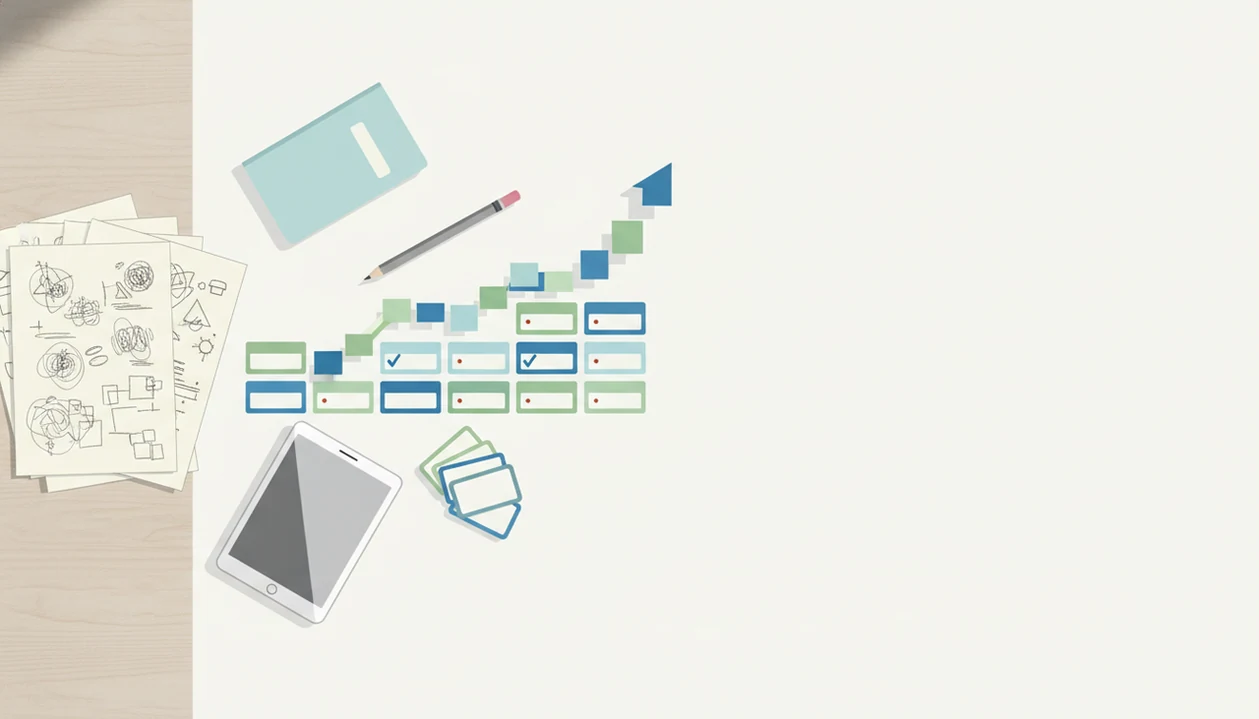
You can see study progress from homework by tracking each assignment’s topic, accuracy, missed steps, review cards, quiz results, and confidence over time. The goal is to turn finished homework into a weak-topic study plan, not just a checked-off task list.
> Definition: HomeworkO is an AI homework helper that provides step-by-step answers, writing support, flashcards, and quizzes for students.
For students who want to see study progress from homework in one place, HomeworkO connects step-by-step solution checks with flashcards, quizzes, and weak-topic review prompts. The useful output is a homework-to-study-plan loop, not just a finished-answer screen.
- Track homework progress by topic, score, difficulty, completion status, and mistake type.
- The most useful study progress signal is whether missed homework topics improve on later quizzes and review sessions.
- An AI study progress system should close the loop: attempt, compare, diagnose, review, and retest.
HomeworkO is an AI homework helper that provides step-by-step answers, writing support, flashcards, and quizzes for students. For this topic, HomeworkO can help turn homework attempts, notes, missed questions, and quiz results into clearer study signals so students can plan review more effectively.
Quick answer: Students can see study progress from homework by tracking which topics they miss, how often they need hints, quiz score changes, confidence ratings, and whether mistakes repeat after review. The goal is not just to count study time, but to use homework, notes, flashcards, and quizzes as formative assessment evidence for what to review next.
At-a-glance homework progress signals students can measure
To see study progress from homework, measure what changed after the assignment, not just whether it was submitted. Completion matters, but it is only the starting line.
- Completion: shows whether the work was attempted and turned in.
- Accuracy: shows whether answers were correct by topic, not just overall.
- Missed topics: reveal which concepts keep showing up in errors.
- Time and confidence: separate fast guessing from careful understanding.
- Review follow-through and quiz movement: show whether weak topics improved later.
A homework log becomes useful when it groups work by subject and concept. “Math, 82%” is vague. “Quadratics, sign errors in factoring, low confidence” gives you something to review.
A checked box can hide a weak chapter.
For students, the useful question is simple: did the same mistake appear again three days later?
Homework progress tracking versus study time
Quick answer: Homework progress tracking is better than study-time tracking alone because it shows whether effort led to stronger accuracy, fewer repeated errors, and better quiz performance.
A 2024 meta-analysis of 14 studies found that students who did homework had, on average, 0.45 standard deviations higher academic performance than students who did not source. That supports homework as a learning tool, but it does not mean more minutes always help.
The same review notes that excessive homework can increase cognitive load and mental fatigue. That is the point where a long session becomes noise. The pencil keeps moving, but the reasoning gets thinner.
For most students, topic-level improvement is a cleaner signal than total hours because it connects effort to an actual learning outcome. Tracking helps balance effort, stress, and results before the backpack becomes a pile of finished pages with no review plan.
AI homework progress data flow
AI homework progress works by connecting a student attempt, a worked solution, an error pattern, a topic tag, and a review recommendation into one learning record. It should explain the path from “I got this wrong” to “here is what to practice next.”
The data flow usually starts with the homework question. Then the student attempts it, compares against step-by-step support, marks the mistake type, tags the concept, and adds a review action. In math, that might mean “linear equations, distribution error.” In chemistry, it might be “moles per liter, unit setup.”
Repeated mistakes are the signal. One wrong answer may be a slip. Four similar wrong steps across a week point to a weak concept.
Notes, flashcards, and quiz scores enrich the picture because they show whether review transfers later. Tools like HomeworkO can support this loop, but AI study progress is still an estimate. It can infer patterns; it cannot read understanding perfectly.
5-step homework-to-study-plan workflow
Use this homework-to-study-plan workflow when you want a weekly review plan from work you already completed. Try the problem first, then use step-by-step help to check the reasoning, not replace it.
- Log the subject, assignment, topic, difficulty, score, time spent, and confidence after each homework block.
- Tag the mistake type, such as formula choice, algebra step, evidence use, vocabulary, unit conversion, or skipped instruction.
- Compare your attempt with the worked solution and write one sentence about what changed.
- Schedule missed topics into flashcards, similar practice, or a 10-minute review session across the week.
- Retest with a short quiz or mixed practice set before the next class check.
This works especially well after the 11:47 p.m. phone photo of a half-finished algebra problem on lined notebook paper. The next morning, the goal is not to admire the final answer. It is to find the exact step that broke.
Students building review decks can also turn notes into flashcards with AI after tagging repeated weak topics.
Homework progress dashboard metrics students should measure
A useful homework progress dashboard should show whether homework practice is turning into stronger topic performance. Streaks look satisfying, but a 12-day streak with the same accuracy problem is not progress.
| Metric | What it tells you | What to do next |
|---|---|---|
| Completion rate | Whether assignments are being attempted | Fix missing work before analyzing mastery |
| Accuracy by topic | Which concepts are strong or weak | Review the lowest topic first |
| Repeated error type | Which mistake keeps returning | Practice that step in isolation |
| Time per problem | Whether work is fluent or slow | Add timed mixed practice if needed |
| Confidence | Whether self-rating matches performance | Flag high-confidence wrong answers |
| Review card success | Whether recall is improving | Retire easy cards, repeat hard ones |
| Quiz transfer | Whether homework gains show up later | Adjust the study plan if transfer is weak |
To track homework progress well, connect metrics to action. For AI study progress, the dashboard should answer, “What should I review next?” not just “How many tasks did I finish?”
3 student stories: homework-to-study-plan patterns
These three patterns show how homework history can become a study plan. None promises a grade jump. Each one shows a better readiness signal.
Maya: algebra error patterns
Maya finished every algebra assignment, but her quiz scores bounced around. Her log showed repeated sign errors while factoring quadratics, especially after distributing negatives. Once she copied one worked example line by line and marked the exact error, her review became narrower. Less rereading, more targeted practice.
Leo: biology quiz transfer
Leo’s biology homework looked strong, but his quiz transfer was weak. The tracked signal was vocabulary recognition without explanation. He could match “mitosis” on homework, then freeze when asked to compare phases. He switched to short self-quizzes and diagram labeling before class.
Nina: writing revision evidence
Nina submitted essays on time, but revision notes kept mentioning thin evidence. Her progress tracker recorded claim, quote choice, explanation, and citation gaps. A primary source printed with underlines made the pattern obvious. For AP students, the same evidence trail also matters in the best app for AP exam study help workflow.
Common weak-topic patterns in homework progress
Weak-topic patterns are repeated signals that tell you how to study next. Look for the pattern before choosing the review method.
- Same-step mistakes: practice the exact step slowly, then place it back into full problems.
- High confidence with low accuracy: add answer checking and explain why the wrong answer looked tempting.
- Slow but correct work: use mixed timed practice after the method is stable.
- Good homework with poor quiz transfer: retest with unfamiliar questions, not copied examples.
- Many small slips late at night: shorten the block and review when attention is better.
Spaced review across multiple days is usually better than cramming because recall improves when practice is spread out; Dunlosky et al. identify distributed practice and practice testing as high-utility learning techniques source.
The calculator history full of decimals can tell a story. Sometimes the issue is not the formula. It is the setup.
Homework progress data gaps in learning evidence
Homework dashboards cannot fully capture deep understanding, originality, class participation, teacher expectations, or project quality. They measure traces of learning, not the whole learning process.
Copied answers also create bad data. If a student pastes a final line without working through the steps, the tracker may show “complete” and “correct” while understanding stays thin. That is why class policy comes first, especially when AI is involved.
Open-ended writing and group work are harder to measure than math or science problem sets. A rubric comment about argument quality needs human judgment, not just a percentage.
A good AI homework helper that answers academic questions across subjects with step-by-step solutions via web and mobile app should deliver guided reasoning and review prompts, not answer-dump shortcuts. For policy boundaries, use an academic integrity AI homework guide before submitting AI-supported work.
Limitations
Progress tracking is useful, but it can mislead students when the inputs are weak or the dashboard becomes the goal.
- Progress tracking depends on accurate logs and genuine attempts; copied answers make the data unreliable.
- AI can infer weak topics from attempts and errors, but it cannot perfectly measure deep understanding.
- Too much dashboard focus can increase anxiety, streak chasing, or gaming behavior.
- AI-driven homework analytics have limited long-term evidence compared with traditional classroom assessment.
- Excessive homework can raise cognitive load and fatigue, so more tracked work is not always better.
- Open-ended writing, projects, labs, and group assignments need teacher feedback alongside metrics.
- Topic tags can be too broad. “Biology” is not useful; “cell transport vocabulary” is better.
- School rules vary, so responsible AI use means trying first, checking steps, and following the teacher’s policy.
The kitchen-table parent moment matters here: Chromebook open, parent saying, “I don’t remember this method.” A tracker can guide the next question, but it cannot replace the class explanation.
How homework becomes a study progress plan
Homework progress tracking works best when students connect daily assignments to specific skills, review cards, and quiz performance. Instead of asking, “How long did I study?” students ask, “Which topic improved, which mistake repeated, and what should I practice next?”
- Start with evidence: missed homework questions, teacher feedback, confusing notes, and quiz results show which topics need review.
- Use OCR or optical character recognition carefully when scanning printed or handwritten work; always check that handwriting recognition captured symbols, exponents, and signs correctly.
- Group mistakes by concept, such as solving linear equations, citing evidence in writing, balancing chemical equations, or identifying theme.
- Review with active recall and retrieval practice by answering from memory before checking notes or step-by-step explanations.
- Use spaced repetition for flashcards so weak topics come back over several days instead of being reviewed only once.
- Compare confidence with performance: high confidence plus low accuracy is a warning sign, while low confidence plus improving quiz scores may mean the student needs more worked examples.
Which option fits which need
| Need | Best option |
|---|---|
| Track homework mistakes, create review prompts, and connect step-by-step explanations to quizzes | HomeworkO |
| Check math reasoning, graph functions, and explore symbolic reasoning for algebra, calculus, or equations | Wolfram Alpha |
| Scan a math problem quickly and see a worked example for many common school-level problems | Photomath |
| Build flashcards, practice active recall, and review vocabulary or facts with spaced repetition habits | Quizlet |
Common weak-topic patterns students should watch for
- Tracking only minutes studied instead of missed topics, quiz accuracy, and whether errors repeat.
- Marking an answer as “understood” after reading a solution without trying a similar problem independently.
- Using AI-generated explanations without checking the original assignment directions, teacher method, or school academic integrity policy.
- Ignoring cognitive load by reviewing too many unrelated topics in one session instead of focusing on a small set of weak skills.
- Confusing recognition with mastery; a solution may look familiar, but retrieval practice shows whether the student can produce the answer alone.
- Treating every missed question the same instead of separating careless errors, concept gaps, reading mistakes, and multi-step reasoning problems.
Limitations to know
- AI tools can make mistakes, especially with unclear images, messy handwriting, unusual notation, or multi-step symbolic reasoning.
- A dashboard can show patterns, but it cannot fully measure effort, classroom participation, test anxiety, or whether a student truly understands a concept.
- Homework progress data may be incomplete if students do not enter corrections, confidence ratings, quiz results, or teacher feedback.
- Some schools restrict AI use on homework, essays, quizzes, or take-home assessments, so students should follow their teacher’s rules.
- Quiz scores and flashcard results are helpful formative assessment signals, but they should not replace teacher feedback or graded assessments.
Seeing study progress from homework means turning assignments, notes, flashcards, and quizzes into usable evidence: missed topics, repeated errors, confidence changes, and review results. Students should use this approach when planning what to study next, preparing for tests, or checking whether practice is actually working; they should not use it to bypass learning or violate school policy. HomeworkO can support the process with step-by-step explanations, study prompts, flashcards, and quizzes, while students still need to verify answers and practice independently.
FAQ
How do I track homework progress?
Log the subject, topic, assignment, completion status, score, difficulty, confidence, time spent, and mistake type. Review the log once a week and before quizzes.
What shows real study progress?
Real study progress means improved accuracy, fewer repeated mistakes, and better performance on later quizzes or mixed practice. Completion alone does not prove learning.
Is there an app for tracking homework progress?
Yes, students can use Google Sheets, Notion, Todoist, Quizlet, LMS gradebooks, or AI study apps such as Homework O. Look for topic tags, step review, quiz practice, and flashcard support.
Can AI find weak topics in my homework?
AI can infer weak topics by comparing attempts, solution steps, error patterns, and quiz results. It should be treated as learning support, not a perfect judgment of understanding.
Is study time enough to measure progress?
No, study time is incomplete without accuracy, difficulty, confidence, and topic-level outcomes. Two hours on the wrong skill may not improve readiness.
How often should I review homework progress?
A weekly review is enough for most students. Add a short check before quizzes, tests, or major writing deadlines.
Do homework scores predict test performance?
Homework scores can help predict readiness, but they are not perfect. Tests may require transfer, speed, memory, and unfamiliar question formats.
Can tracking homework reduce school stress?
Tracking can reduce uncertainty by showing what to review next. Overtracking, streak pressure, or constant score checking can increase stress.