
Turn Notes Into Flashcards With AI for Active Recall
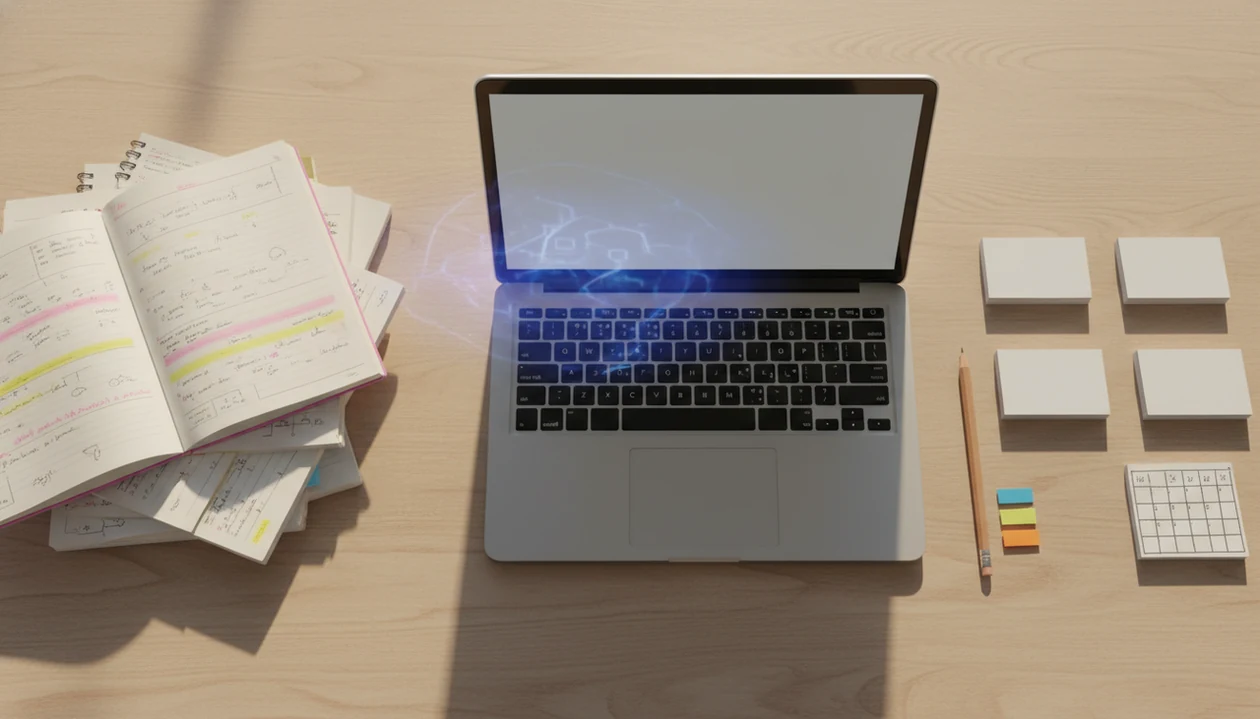
To turn notes into flashcards with AI, paste or upload your class notes, ask the AI to extract testable facts, then edit every card before you study. The strongest results come from active recall prompts, verified answers, and a spaced review schedule instead of simply generating a huge deck.
> Definition: AI note-to-flashcard conversion is the process of using an AI study tool to turn class notes, PDFs, slides, or solved examples into question-and-answer cards for self-testing.
TL;DR - Use AI to draft flashcards from organized notes, not messy or incomplete material. - Keep only cards that test key concepts, problem steps, definitions, comparisons, and likely exam questions. - Check every AI-generated answer against your notes, then review cards with active recall and spaced repetition.
HomeworkO is an AI homework helper that provides step-by-step answers, writing support, flashcards, and quizzes for students. For this topic, it can help students convert class notes into review cards while still requiring students to verify accuracy, edit wording, and practice with spaced repetition.
Quick answer: You can turn notes into flashcards with AI by giving it clear class notes, asking for question-and-answer cards, and checking each answer against your textbook or teacher’s examples. The best flashcards support active recall, so they should ask you to retrieve ideas, definitions, steps, and examples instead of simply rereading your notes.
What It Means to Turn Notes Into Flashcards With AI
AI note-to-flashcard conversion means using software to read pasted notes, PDFs, lecture slides, or solved examples and draft question-and-answer cards for study. The AI finds likely test material, then turns it into prompts you can answer from memory.
It is a drafting assistant, not an answer key. You still need to check the facts, clean up vague cards, and make sure the explanation matches your class.
A good AI homework helper that answers academic questions across subjects with step-by-step solutions via web and mobile app should deliver guided reasoning and study practice, not finished work to submit as your own. Tools like HomeworkO can turn step-by-step explanations into study cards after you understand the method.
The copied final line and the worked solution are not the same thing.
How AI Note to Flashcard Tools Work Behind the Scenes
AI note-to-flashcard tools work by taking your input, segmenting it into topics, detecting key terms, generating prompts, and pairing those prompts with short answers. In plain English, the model looks for what seems important and reshapes it into self-test format.
The system often uses signals such as headings, repeated terms, bolded definitions, formulas, examples, and cause-effect language. A section titled “Newton’s Second Law” with a circled formula is easier to convert than a loose page of half-finished notes.
Still, the model is guessing from patterns. It may over-compress a process, miss a teacher’s side comment, or create a card that sounds right but skips a condition. That is why the review step matters. The formula circled in red pen might need units, assumptions, or a “when not to use this” note.
Why Flashcards From Class Notes Work for Active Recall
Flashcards from class notes work when they force active recall, which means answering before looking. Spaced repetition adds timing: you review cards at increasing intervals instead of cramming the night before.
- Active recall is self-testing, not rereading; meta-analysis research found retrieval practice improves learning compared with restudying source.
- A classroom study found repeated testing produced higher long-term retention than repeated studying after a week-long delay source.
- A randomized trial found spaced repetition flashcards improved vocabulary recall by about 15–25 percentage points compared with massed practice after one week source.
- Research on student study strategies shows many learners rely on rereading and highlighting more than retrieval practice or planned spacing source.
For most students, a small verified deck reviewed on a schedule is better than a large unedited deck opened once.
Before You Make Flashcards From Notes AI Can Read
Clean notes make better AI flashcards. Remove duplicated text, unrelated screenshots, confusing fragments, and anything copied from a source you do not understand.
Label sections by chapter, lecture date, topic, and exam unit. Keep formulas, definitions, worked examples, teacher hints, and mistakes from homework solutions. Those mistakes are useful. A card that asks “What went wrong in this setup?” often teaches more than another definition card.
Messy input creates messy output. If your notes include three units, two lab tables, and a random paragraph draft with tracked edits, the AI may blend them into one strange deck. Students preparing for AP exams can connect cleaned flashcard sets with a broader best app for AP exam study help workflow.
Step 1: Select High-Value Notes for AI Flashcards
What notes should you turn into AI flashcards? Choose material that is likely to be tested: definitions, causes, effects, formulas, processes, comparisons, and teacher-emphasized points.
Do not turn every sentence into a card. That creates review drag. The deck looks productive, but you end up tapping through trivia instead of practicing the ideas that decide your score.
For problem-heavy subjects, select solved examples and common mistake patterns. A whiteboard covered in vectors can become cards about direction, components, units, and sign errors. In chemistry, a missed “moles per liter” unit is not a tiny detail. It changes the meaning.
For problem-heavy courses, fewer cards built from worked examples are often easier to use than hundreds of isolated fact cards because they preserve the reasoning path.
Step 2: Prompt AI to Create Exam-Style Flashcards From Class Notes
Prompt the AI like a study partner, not a copy machine. Ask for exam-style cards, several card types, and answers tied only to the notes you provide.
If you plan to export the cards, ask for a simple front/back format that can be pasted into Anki, Quizlet, RemNote, or your school-approved flashcard app. That prevents the AI from creating pretty cards that are hard to review on a schedule.
Include definition, concept, application, comparison, and error-checking cards. You can also ask for Bloom’s taxonomy levels: remember, understand, apply, and analyze. That helps prevent a deck full of “What is ___?” cards.
Copy-and-paste AI flashcard prompt
“Turn these lecture notes into 20 exam-style flashcards ranked by difficulty. Include definition, concept, application, comparison, and error-checking cards. Keep each answer concise and use only the information in my notes. Label each card as remember, understand, apply, or analyze. If a detail is unclear or missing, mark it as ‘check notes’ instead of guessing.”
A student toggling between an LMS tab, a PDF rubric, and an AI tool should keep the rubric visible. Class policy comes first, especially for graded review assignments; our academic integrity AI homework guide covers that boundary.
Step 3: Edit AI Note to Flashcard Answers for Accuracy
Edit every AI note-to-flashcard answer before studying it. Check the back of each card against the original notes, textbook, rubric, or teacher example.
Delete cards that are too vague, too easy, duplicated, or unsupported by the notes. Split overloaded cards into one fact, comparison, or reasoning step per card. “Explain cellular respiration” is not one useful card. It is probably five.
Add missing caveats, units, conditions, diagrams, and formula meanings when needed. In physics, “acceleration” should not float without meters per second squared when units matter. In biology, a diagram label may carry half the answer.
Tiny fixes count.
When a card feels almost right, slow down. The “almost” is where exam mistakes usually hide.
Step 4: Review AI Flashcards With Spaced Repetition
Use AI flashcards for retrieval practice, then let a schedule decide what returns next. Short daily review sessions usually beat one long cram session because missed cards come back while they are still fixable.
- Answer the front of the card aloud or in writing before revealing the back.
- Check your response against the answer and your original notes.
- Rate the card as easy, shaky, or missed.
- Reschedule easy cards later and missed cards sooner.
- Revisit missed homework questions by turning the explanation into follow-up cards.
After an 11:47 p.m. phone photo of a half-finished algebra problem on lined notebook paper, an explanation can become three cards: setup, mistake check, and final-unit check. Apps such as HomeworkO and Homework O can help students convert missed steps into flashcards and quizzes after the homework solution is understood. A planned flashcard study timeline helps keep those reviews from piling up the night before the test.
Common Mistakes When Students Make Flashcards From Notes AI Generates
AI-generated flashcards are drafts. Treating them as automatically correct is the fastest way to study an error until it feels familiar.
- AI cards can contain wrong facts, missing conditions, or misleading shortcuts.
- Huge decks often bury the high-value cards under low-value details.
- Rereading cards is weaker than answering first, then checking.
- Passive AI summarizing can reduce real thinking if you never attempt the answer yourself.
- AI flashcard tools generate cards; they do not replace a spaced repetition system or review plan.
The kitchen-table moment is familiar: a Chromebook is open, a parent looks at the worksheet, and says, “I don’t remember this method.” In that situation, AI can explain and draft practice cards, but the student still needs to show the work and check the reasoning.
Limitations
AI flashcard generation saves time, but it has real limits. Use it as learning support, not a shortcut.
- AI can introduce factual errors, hallucinated details, or misleading simplifications.
- AI may miss lecture nuance, teacher emphasis, lab observations, graphs, or multi-step derivations.
- Text-only cards can be weak for geometry proofs, chemistry mechanisms, physics diagrams, and visual subjects.
- Over-reliance can create passive learning if students skip the hard recall step.
- Some tools have upload limits, paywalls, privacy constraints, or school policy restrictions.
- PDF conversion can fail when scans are blurry, columns are mixed, or handwriting is hard to read.
- Students must verify cards before relying on them for quizzes, finals, AP review, or college exams.
If a card affects a graded assignment, check your teacher’s AI rules first. Responsible AI use means you can explain the answer without the tool open.
How to turn class notes into useful AI flashcards
AI note-to-flashcard tools identify important ideas in your notes and rewrite them as prompts for retrieval practice. The strongest workflow is not just copying notes into a generator, but selecting high-value material, prompting for exam-style questions, editing answers, and reviewing over time.
- Start with readable notes. If you upload photos, OCR, or optical character recognition, may be used to turn handwriting or printed pages into text, but handwriting recognition can misread symbols, dates, names, or formulas.
- Choose high-value content: definitions, cause-and-effect relationships, formulas, vocabulary, timelines, lab results, worked examples, and mistakes your teacher emphasized.
- Prompt for different cognitive levels using Bloom's taxonomy: recall cards for facts, application cards for procedures, and analysis cards that ask you to compare, explain, or justify an answer.
- For math and science, ask for cards that include step-by-step explanations and worked examples, not just final answers. This lowers cognitive load during review and helps you notice where a process changes.
- Edit every AI-generated card for accuracy, clarity, and academic integrity. AI can invent details or overgeneralize, so compare the cards to your notes, textbook, rubric, and teacher feedback.
- Review with spaced repetition. Use flashcards as formative assessment: missed cards show what to relearn before a quiz, test, or homework set.
Which option fits which need
| Need | Best option |
|---|---|
| Turn mixed class notes into flashcards and quick review questions | HomeworkO for combining flashcards, quizzes, writing support, and step-by-step explanations in one homework workflow |
| Practice an existing flashcard deck or memorize vocabulary terms | Quizlet for large shared decks and simple spaced review routines |
| Check math steps or symbolic reasoning behind a formula card | Wolfram Alpha for symbolic reasoning and HomeworkO for student-friendly step-by-step explanations |
| Use a phone camera to understand a homework problem before making review cards | Photomath for math camera help, Socratic for broad homework scanning, and Chegg for textbook-style support when allowed by school policy |
Common mistakes when making AI flashcards from notes
- Turning every sentence into a card. Too many low-value cards increase cognitive load and make review feel like copying instead of learning.
- Accepting AI answers without checking them. AI may misread OCR text, confuse similar terms, or create a confident but incorrect explanation.
- Making cards that are too vague, such as “Explain Chapter 4.” Better cards ask one specific question with one clear answer or process.
- Only making definition cards. Exams often require application, comparison, problem solving, and explanation, so include higher-level prompts too.
- Skipping spaced repetition. Reviewing once the night before a test is less effective than short retrieval practice sessions spread across several days.
- Using AI in a way that violates class rules. If your teacher says flashcards are allowed but answer generation is not, follow that policy.
Limitations to know
- AI flashcards are only as good as the notes you provide. Missing lecture details, unclear photos, or incomplete examples can lead to weak cards.
- OCR and handwriting recognition can misread math symbols, chemical formulas, foreign-language accents, and messy handwriting.
- AI may oversimplify complex topics or create cards that do not match your teacher’s wording, grading style, or test format.
- Flashcards are useful for retrieval practice, but they do not replace solving full problems, writing essays, completing labs, or asking questions in class.
- Some schools limit AI use. Students should follow academic integrity rules and use AI-generated cards as study aids, not as a substitute for their own work.
Turning notes into flashcards with AI means using a tool to convert class material into active recall prompts, then editing and reviewing those cards over time. It is helpful before quizzes, unit tests, finals, vocabulary checks, and cumulative exams, especially when paired with spaced repetition and practice problems. It is not a replacement for understanding your notes, checking sources, or following school AI policies. HomeworkO can support the process by helping create flashcards, explain answers step by step, and turn weak spots into quizzes for extra practice.
FAQ
Can AI make flashcards?
Yes. AI can generate draft flashcards from pasted notes, PDFs, slides, textbook excerpts, or solved examples.
Are AI flashcards accurate?
AI flashcards can be useful, but they are not automatically accurate. Check each card against your notes, textbook, teacher examples, or rubric.
Can AI use PDF notes?
Many AI study tools can read PDF notes if the text is clear. After conversion, check headings, formulas, diagrams, and any scanned handwriting.
What notes make good flashcards?
Good flashcard notes include definitions, formulas, key concepts, worked examples, comparisons, causes, effects, and likely test questions. Teacher-emphasized points are usually worth keeping.
How many flashcards per lecture?
Many students start with 10–25 strong cards per lecture, then adjust based on course difficulty. Quality matters more than deck size.
Do flashcards help active recall?
Yes. Flashcards support active recall when you answer before looking at the back of the card.
Should I use spaced repetition?
Yes. A scheduled review plan usually supports longer-term retention better than cramming all cards in one session.
Can an AI homework helper create flashcards?
Yes. HomeworkO supports step-by-step homework help, flashcards, and quizzes for studying. Students should still verify cards and practice the material themselves.