
Flashcard Study Timeline for Homework, Quizzes, and Exam Review
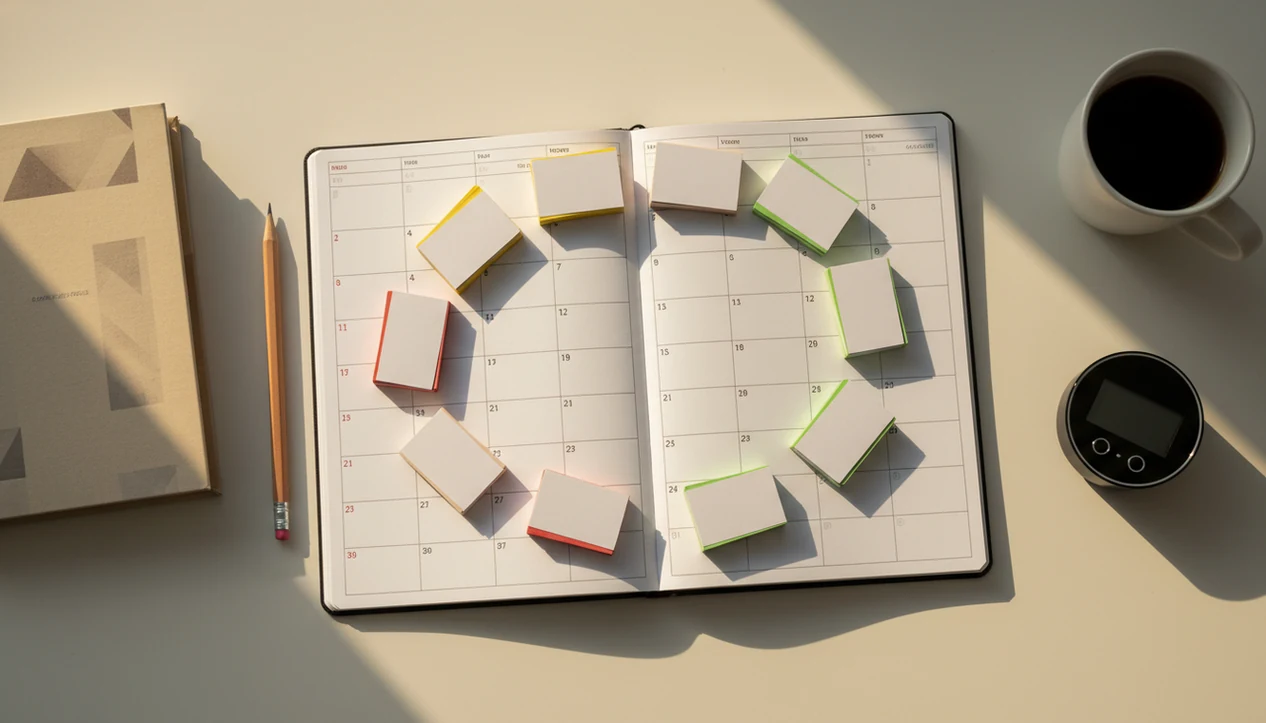
A flashcard study timeline should start the same day you do homework, then repeat short reviews with wider gaps until the quiz or exam. The simplest plan is: make cards after homework, review them the next day, revisit weak cards every 1–3 days, and do a final mixed review before test day.
> Definition: A flashcard study timeline is a day-by-day plan for making, reviewing, and re-reviewing flashcards between homework assignments and an upcoming quiz or exam.
TL;DR
- Start flashcards after homework, not the night before the test.
- Use spaced repetition: review hard cards sooner and easy cards later.
- For exams, plan 3–5 review days instead of one long cram session.
HomeworkO is an AI homework helper that provides step-by-step answers, writing support, flashcards, and quizzes for students. For flashcard study timeline planning, students can use HomeworkO to turn homework ideas into review cards, practice retrieval, and check understanding before quizzes and exams.
Quick answer: A flashcard study timeline is a plan for reviewing cards after homework, before quizzes, and across the days leading up to an exam. The best timelines use active recall and spaced repetition: review soon after learning, return to hard cards more often, and use longer review sessions only when a larger test is near.
Flashcard Study Timeline Definition for Homework and Exams
A flashcard study timeline is a day-by-day plan for turning new material into recall practice before a quiz or exam. It starts when the material is first learned, usually after class, homework, a reading assignment, or a problem set.
The goal is repeated retrieval, not passive rereading. Instead of staring at highlighted notes, you try to answer first, then check the back of the card. That small struggle matters.
Half-erased algebra on notebook paper is enough material.
Students may also call this a spaced repetition timeline, study timeline for exams, or flashcard review schedule. Tools like HomeworkO can help students turn step-by-step homework learning into their own review prompts, but the point is understanding the method, not dumping answers into cards.
Five Flashcard Study Timeline Facts Students Should Know
- Start before the panic window. Starting several days to a week before an exam is usually stronger than cramming, because memory improves when practice is spread out. A distributed practice review found that spaced study is consistently more effective than massed study source.
- Hard cards should return sooner. Spaced repetition means missed cards come back quickly, while easy cards wait longer before the next review.
- The best timeline begins after homework. For most students, making cards while the method is fresh is easier than rebuilding the lesson three nights later.
- Big tests need several passes. One review pass often catches recognition. Multiple days catch whether you can recall, explain, and apply.
- Short sessions beat heroic plans. A realistic 10–30 minute daily schedule is easier to maintain than a two-hour session that gets skipped after one busy day.
If HomeworkO is part of the workflow, use it for step-by-step explanation checks, then write the flashcard in your own words.
Spaced Repetition Timeline Mechanics for Flashcards
Spaced repetition works by combining retrieval practice with timed gaps. Retrieval practice means you try to recall the answer before you look. The spacing effect means the gap makes recall slightly effortful, which can improve later retention.
In one vocabulary study, students using six spaced practice episodes remembered substantially more words after four weeks than students who massed practice into one session source. The plain version: don’t let every card appear every time. Let the schedule react.
Adaptive timing keeps the timeline usable. Missed cards should reappear in the next session, or later the same day if the test is close. Mastered cards can wait longer or leave the deck. A spaced repetition timeline is evidence-informed, not a perfect formula for every learner, course, or exam format.
Check the back only after you try.
Before You Start a Flashcard Study Timeline
Before you build the timeline, know what you are studying for and what materials will feed the cards. A good setup keeps the schedule realistic instead of turning it into another messy assignment.
- Mark the quiz or exam date first. Choose review gaps only after you know the deadline. A Friday quiz and a unit exam two weeks away should not use the same pacing.
- Gather the raw material. Pull together homework mistakes, class notes, formulas, vocabulary, diagrams, and any teacher study-guide topics. The best cards often come from the problems you almost got right.
- Choose one card format. Use paper cards, a spreadsheet, Anki, or Quizlet, but avoid splitting the same deck across three places. One system is easier to review when school gets busy.
- Block real review windows. Find 10–30 minute spaces around practice, work, clubs, dinner, and sleep. A short block you actually do beats a perfect plan you skip.
- Separate math practice from recall cards. For math-heavy classes, use cards for formulas, units, and common errors, then keep full practice problems in a separate work block.
Flashcard Review Schedule After Nightly Homework
How should I review flashcards after nightly homework? Make the cards right after the assignment, then review them the next day, again around Day 3, and once more in a mixed set around Day 5–7.
Turn formulas, vocabulary, mistakes, definitions, and step-by-step solution ideas into cards. A student working at 11:47 p.m. with a phone photo of a half-finished algebra problem should not make one card that says “solve #14.” Better: “When isolating x after distributing, what sign error did I make?”
Use this simple flashcard review schedule:
- Day 0: Make cards after homework.
- Day 1: Review all new cards.
- Day 3: Review missed and medium cards.
- Day 5–7: Mix the deck before the quiz.
If you use step-by-step explanations from HomeworkO, a teacher’s worked solution, Quizlet, or Anki, convert the explanation into your own recall prompts instead of copying final lines blindly. For notes-heavy classes, the workflow in turn notes into flashcards with AI can help keep cards clean.
Five-Step Flashcard Study Timeline Before a Test
Here is how to use a flashcard study timeline before a test. Copy these five steps into a planner, then adjust the review days around sports, work, or family plans.
- Set the test date and count backward. Mark the final review day, then add earlier review blocks before it.
- Make cards after each homework session. Add only the ideas you had to retrieve, explain, calculate, define, or correct.
- Review new cards within 24 hours. Keep this first review short, even if it is only 10 minutes before school.
- Sort cards into hard, medium, and easy piles. Hard cards return tomorrow, medium cards return in two or three days, and easy cards wait longer.
- Reset the final two days for weak cards and mixed practice. Spend one day fixing weak topics and one day mixing all chapters.
For exam-heavy courses, a planner-based study timeline for exams is often easier than “study every night” because each review session has a job.
Study Timeline for Exams by Days Remaining
A study timeline for exams should match the time left before test day. More days allow wider spacing. Fewer days require triage, which means choosing the most testable weak topics first.
Cornell University’s Learning Strategies Center recommends spacing study over multiple shorter sessions instead of relying on one cram block (source). Rogue Community College also recommends studying over several days and using repeated review before exams (source). Same idea, different schedule.
| Time before exam | Flashcard timeline | What to add |
|---|---|---|
| 3 days | Triage weak topics, review daily, and repeat missed cards each day. | Add practice questions so you are not only recognizing terms. |
| 5 days | Make or clean cards early, then use three separate review days. | Save the last day for hard cards and mixed recall. |
| 7 days | Review on Days 1, 2, 4, 6, and the final day. | Use class notes to catch missing chapters. |
| 10+ days | Build cards after each homework session and gradually widen review gaps. | For AP courses, pair flashcards with the best app for AP exam study help. |
Common Flashcard Study Timeline Myths
Short, repeated recall sessions beat one passive pass through a deck. These myths are where many flashcard timelines break down.
- Myth 1: Night-before flashcards are the same as spacing. Cramming can help recognition tomorrow, but it is not the same as revisiting cards over several days.
- Myth 2: A timeline requires hours every day. Many students do better with 10–30 focused minutes than with a marathon they avoid.
- Myth 3: Spaced repetition is only for languages or medical school. It also fits history terms, biology processes, formulas, grammar rules, and literature vocabulary.
- Myth 4: Flipping through every card once is enough. Reading the answer too quickly skips retrieval.
Problem-solving subjects need more than cards. A calculus derivative beside coffee stains still needs practice problems, not just a card that names the rule.
Hard Card Adjustments in a Flashcard Review Schedule
Hard cards should change the schedule. If you miss a card, move it to the next session or a same-day retry pile. If you answer a card correctly three times across separate sessions, delay it or retire it.
Repeated misses often mean the card is vague, too broad, or copied without understanding. Rewrite it before you blame your memory.
Bad card: “Photosynthesis.” Better card: “What are the reactants and products of photosynthesis?”
Bad card: “Newton’s second law.” Better card: “How do you find acceleration when force and mass are given, and what unit should the answer use?”
That unit check matters. Meters per second squared is not decoration.
Limit new cards to the most testable ideas. If your deck grows faster than you can review it, the timeline becomes a time sink. Students using Homework O should still verify the formula, units, and assumptions before turning an explanation into a card.
Limitations
A flashcard study timeline is useful, but it cannot carry every kind of learning task. Use the explanation, not just the final line.
- A timeline will not fix vague, copied, or poorly written cards.
- Flashcards work best for recallable facts, terms, formulas, definitions, and concepts.
- Math, writing, coding, and multi-step reasoning still require practice problems, drafts, or debugging.
- Exact spacing gaps are not one-size-fits-all for every course, student, or exam date.
- Too many cards can turn a good schedule into a time sink.
- Research supports spacing, but it does not identify one universal interval for every subject and learner.
- Class policy comes first when AI tools are involved. The academic integrity AI homework guide explains where study support can cross into misuse.
At the kitchen table, a parent may read the prompt aloud and say, “I don’t remember this method.” That is the moment for a worked explanation, then a practice card, not an answer shortcut.
Flashcard study timeline definition for homework and exams
A flashcard study timeline organizes when you make, review, and adjust flashcards so studying does not become last-minute cramming. The goal is to practice retrieval at the right times: soon after homework, again before a quiz, and repeatedly before a major exam.
- After nightly homework, make a small set of cards from formulas, vocabulary, steps in a method, missed questions, and teacher emphasis points.
- Use active recall before checking the answer; do not just reread the front and back of the card.
- Apply spaced repetition by reviewing new cards within 24 hours, then again after longer gaps if you answer correctly.
- Move hard cards into shorter review intervals so they appear more often than cards you already know.
- For test prep, combine flashcards with worked examples, practice problems, and formative assessment so you can apply ideas, not just recognize terms.
- Keep cognitive load manageable by limiting each card to one idea, one formula use, one definition, or one decision step.
Which option fits which need
| Need | Best option |
|---|---|
| Turn homework notes, missed questions, and explanations into study cards with step-by-step support | HomeworkO |
| Drill vocabulary, definitions, and quick recognition with large flashcard sets | Quizlet |
| Check symbolic reasoning, algebra steps, graph behavior, or exact math input | Wolfram Alpha |
| Scan a printed or handwritten math problem using OCR or handwriting recognition for guided help | Photomath, Socratic, or HomeworkO depending on the problem type |
Common flashcard study timeline myths
- Waiting until the night before a quiz, which removes the benefit of spaced repetition and usually increases cognitive load.
- Making cards that are too broad, such as an entire chapter concept on one card, instead of one testable idea at a time.
- Flipping cards too quickly without retrieval practice; you should try to answer before looking.
- Marking a card as mastered after one correct answer, even if you guessed or needed hints.
- Studying only definitions when the test requires Bloom's taxonomy skills such as applying, analyzing, or explaining.
- Copying AI-generated answers or card text without checking accuracy, class notes, or academic integrity rules.
Limitations to know
- Flashcards work best for facts, terms, formulas, steps, and quick recall; they are not enough by themselves for essays, proofs, lab reasoning, or multi-step problem solving.
- AI-generated cards and explanations can contain errors, so students should compare them with class materials and teacher instructions.
- OCR and optical character recognition may misread handwriting, symbols, fractions, or diagrams, especially in math and science problems.
- Some schools limit AI use for homework, writing, or test preparation, so students should follow course policy and use tools for learning rather than submitting unsupported answers.
- A review schedule cannot replace sleep, class participation, teacher feedback, or real practice with exam-style questions.
A flashcard study timeline is a practical review plan that starts after nightly homework, continues before quizzes, and expands in the days before an exam. Use it when you need active recall, spaced repetition, and quick formative assessment, but do not rely on flashcards alone for deep writing, complex math, or full exam practice. HomeworkO can help create cards from homework topics, explain steps, and generate quizzes, while students still need to verify answers and follow school rules.
FAQ
When should I start making flashcards for a quiz or exam?
Start the same day you learn the material, ideally after homework or class. Waiting until the night before leaves less time for spaced review.
How often should I review flashcards before a test?
Review new cards the next day, then revisit them every few days. Hard cards should come back sooner than easy cards.
Is cramming flashcards the night before a test effective?
Cramming can help short-term recognition. It is usually weaker than spaced review for retention and transfer.
How long should each flashcard study session be?
Most sessions should be 10–30 minutes. Increase the time only when the test is large or the deck is still weak.
What is a spaced repetition timeline for flashcards?
A spaced repetition timeline is a review schedule where gaps increase as recall improves. Missed cards return sooner, and easy cards return later.
How many flashcards should I make for one chapter?
Focus on testable concepts, mistakes, formulas, definitions, and examples. Do not make a card for every sentence.
Should I keep reviewing flashcards that already feel easy?
Review easy cards less often. Retire them after repeated correct answers across separate sessions.
Do flashcards work for math homework and exams?
Flashcards help with formulas, units, definitions, and common mistakes. They must be paired with practice problems and shown work.