Free AI Biology Solver
Get instant answers to any biology question. Upload diagrams, type your question, and receive step-by-step explanations for genetics, cell biology, ecology, and more.
Upload an image of your biology question or diagram
Analyzing your biology question...
HomeworkO is an AI homework helper that provides step-by-step answers, writing support, flashcards, and quizzes for students. On this page, the AI biology solver focuses on helping students understand living systems, solve biology problems, and prepare for quizzes and tests without simply memorizing terms.
Quick answer: An AI biology solver helps students work through biology homework by explaining concepts, interpreting questions, and showing step-by-step reasoning for topics like genetics, cell biology, ecology, evolution, and biochemistry. HomeworkO can be used to check your understanding, study for exams, and turn confusing textbook problems into clearer worked examples.
What Is an AI Biology Solver?
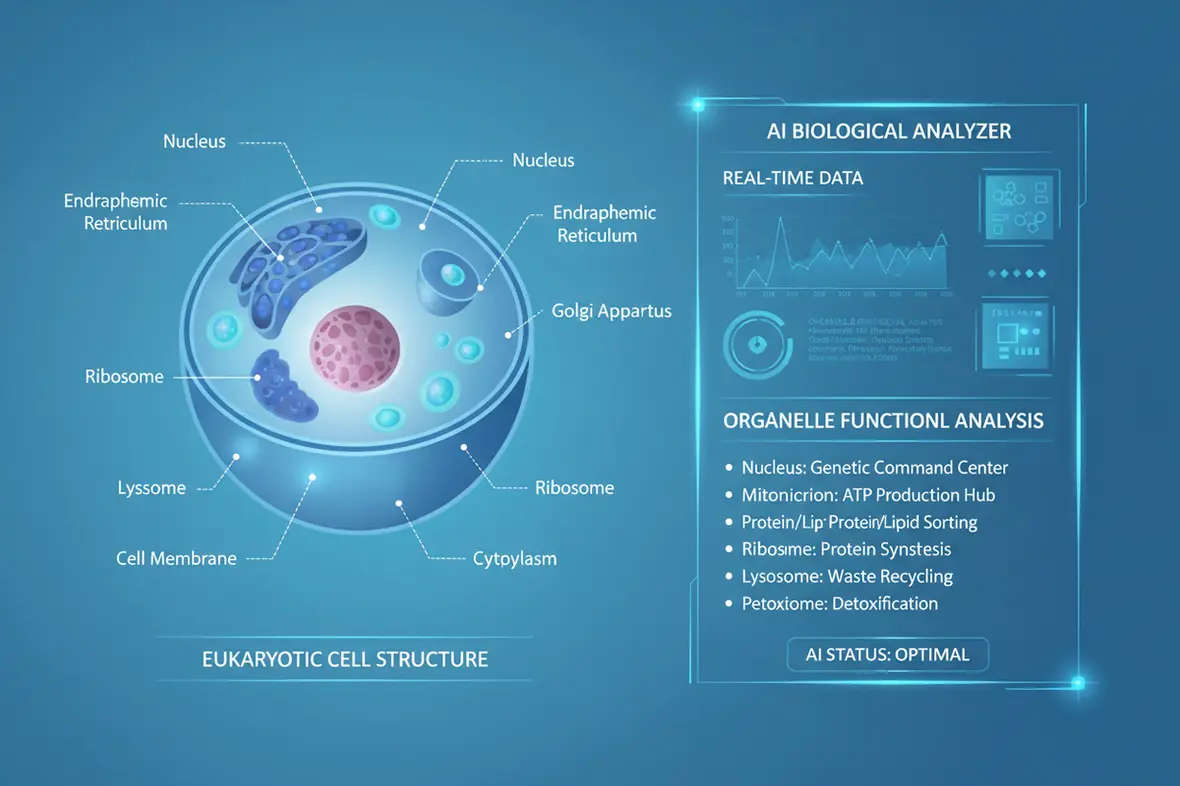
An AI biology solver is a tool that uses artificial intelligence to answer biology questions and provide detailed explanations across all major biology topics. Students submit questions as text or upload images of diagrams, Punnett squares, lab data, or handwritten problems, and the AI generates structured answers. The tool covers cell biology, genetics, evolution, ecology, anatomy, physiology, molecular biology, and biochemistry.
HomeworkO's AI biology solver uses GPT-4o-mini to interpret biology questions and produce step-by-step explanations. It handles both conceptual questions and quantitative problems like genetics crosses and population ecology calculations. The solver accepts typed input and image uploads, recognizing biological diagrams and handwritten content. Five free uses are available daily with no signup required, and unlimited access is available through the AI Homework Helper on iOS and Android. AI-generated biology answers should be verified against course materials and peer-reviewed sources. The tool does not replace laboratory instruction or guidance from qualified biology educators.
Biology Homework Help Beyond the Textbook
Biology isn't just memorization, despite what every non-science major thinks. Sure, you need to know the difference between mitosis and meiosis, but the exam question won't ask you to define them — it'll ask you to explain what happens when nondisjunction occurs during meiosis II and predict the chromosomal outcome. That's a different kind of knowing.
The AI biology solver handles those application-level questions. Upload a Punnett square and get the genotype ratios explained. Ask about cellular respiration and get the full pathway with ATP yields at each stage. It gives you the connected explanation that links vocabulary to function to outcome — the level of understanding that actually shows up on exams.
How to Use the AI Biology Solver
Get biology answers in three simple steps.
Enter Your Biology Question
Type your biology question directly or upload a photo of a diagram, Punnett square, lab data table, or handwritten problem. Include all relevant details for the most complete answer.
AI Generates an Explanation
The AI identifies the biology topic, applies the correct concepts, and generates a structured answer with step-by-step reasoning, definitions, and diagrams descriptions as needed.
Review & Study
Read through the explanation, connect the concepts to your course material, and use the answer to deepen your understanding of the topic for assignments and exams.
Solve Genetics Problems with AI
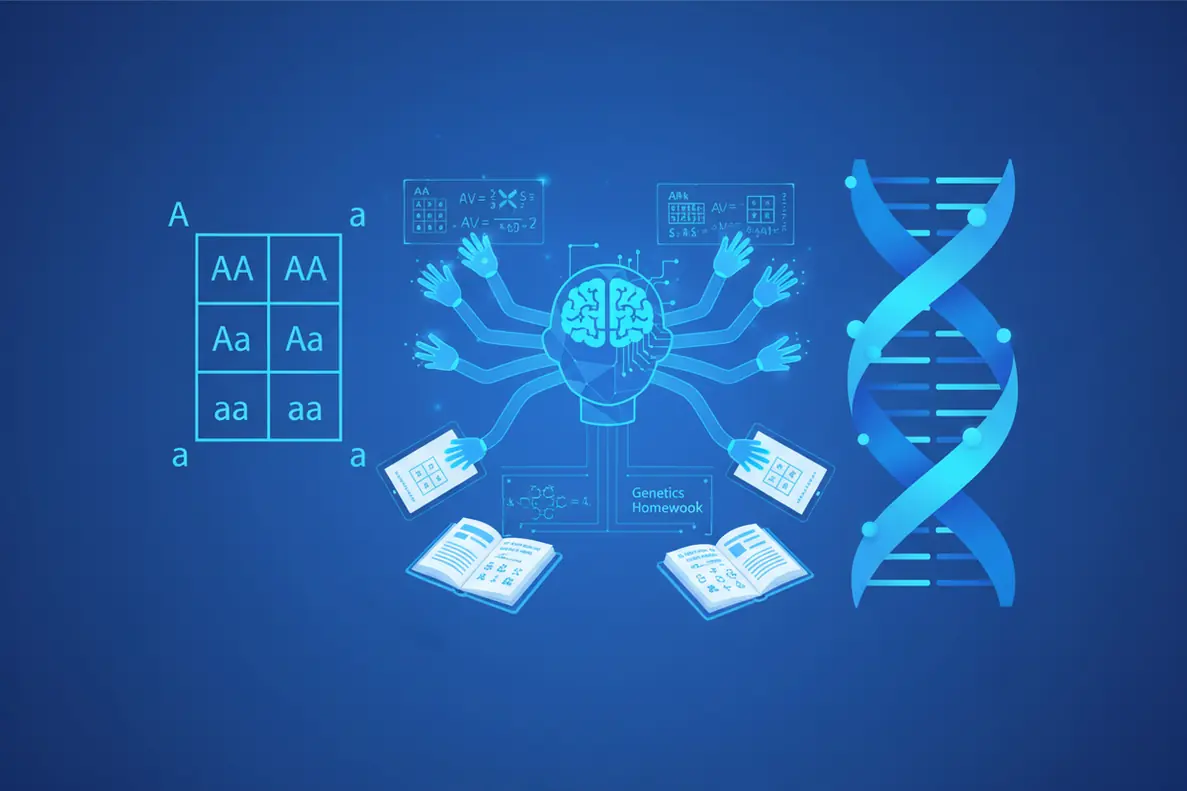
Genetics problems are deceptively tricky. A simple monohybrid cross is fine until incomplete dominance shows up, or the question involves two genes on the same chromosome, or there's a pedigree with an ambiguous inheritance pattern and you have to figure out if it's autosomal or X-linked. Each layer adds complexity that pure memorization can't handle.
The AI bio solver breaks genetics problems into their components. It sets up the cross, draws out the Punnett square, calculates the ratios, and explains what each genotype means phenotypically. For pedigree analysis, it walks through the logic of ruling out inheritance patterns one by one. You see the reasoning, not just the final 3:1 ratio, which is what you need to tackle the next problem independently.
Understanding Biological Processes, Not Just Naming Them
The difference between a B and an A in biology often comes down to depth. Anyone can list the stages of cellular respiration — glycolysis, Krebs cycle, electron transport chain. But can you explain why cyanide is lethal at the molecular level, or why anaerobic organisms stop at fermentation, or what happens to the proton gradient when the inner mitochondrial membrane becomes leaky? Those connections are what professors test.
The AI biology solver provides that depth. Instead of giving you a list of stages, it explains the functional logic — why each step feeds into the next, what would happen if a specific enzyme were inhibited, how the energy accounting works across the whole pathway. It's the difference between a study guide and a conversation with someone who actually understands the material and can explain why it matters.
Ecology, Evolution, and Population Biology
Ecology questions look qualitative until they hit you with a Hardy-Weinberg calculation or a population growth model with carrying capacity. Suddenly you need math in what you thought was the "memorization" part of biology. And evolution questions want you to connect genetic variation, natural selection, and population-level outcomes in a coherent narrative — which is harder than it sounds when you're staring at a blank answer box.
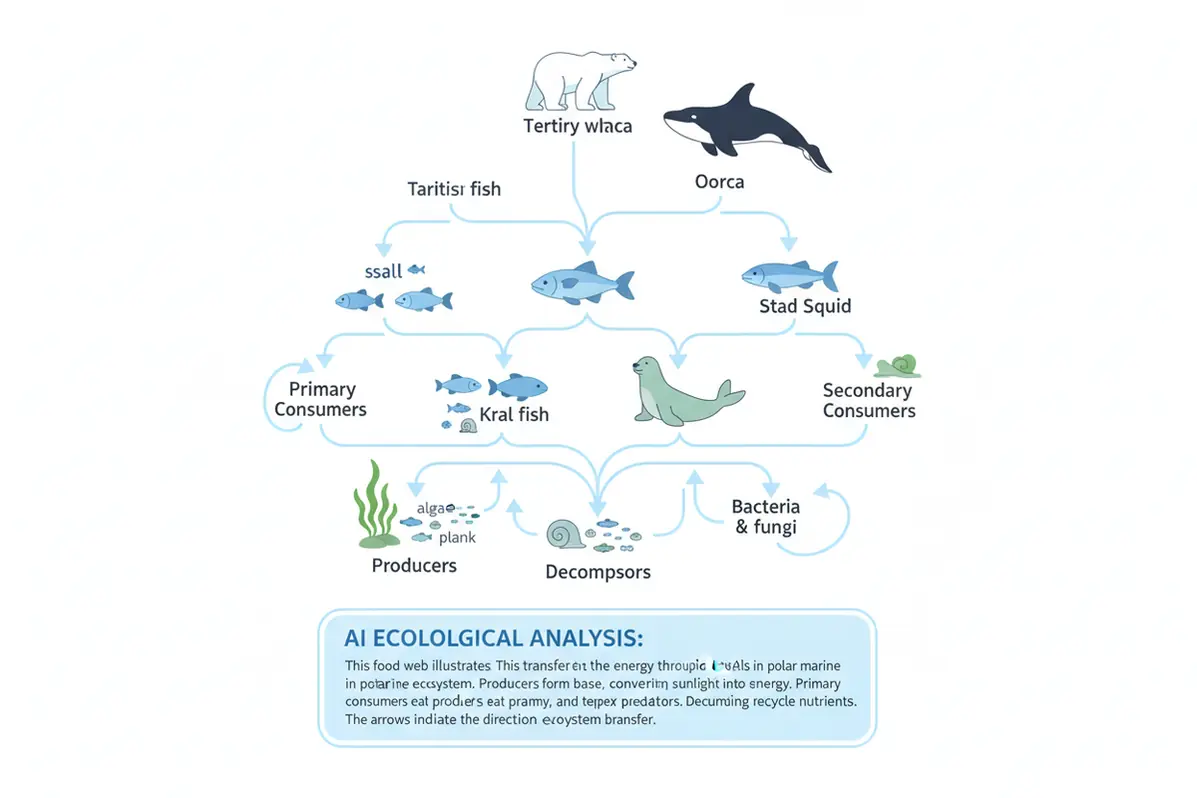
The AI biology solver handles both the conceptual and quantitative sides. For population genetics, it shows the allele frequency calculations step by step. For ecology, it explains food web dynamics, energy transfer between trophic levels, and the factors driving community succession. For evolution, it connects mechanisms to outcomes with the specificity that earns full marks on essay questions.
Use the Biology Solver for Exam Preparation
Biology exams reward students who can apply concepts to novel scenarios. Your professor won't reuse the textbook examples — they'll describe an experiment you've never seen and ask you to predict outcomes, identify controls, or explain unexpected results. Rereading your notes won't prepare you for that. Working through practice problems and checking your reasoning will.
Use the AI biology solver as your study partner for active review. Answer practice questions on your own first, then compare your response to the AI's explanation. When your genetics cross gives the wrong ratio, the step-by-step comparison shows exactly where the error crept in. When your ecology answer misses a key factor, you see what you overlooked. That targeted, problem-specific feedback builds the kind of flexible understanding that transfers directly to exam performance.
Molecular Biology and Biochemistry Problem Solving
Molecular biology sits at the intersection of biology and chemistry, and that crossover confuses students who thought they were done with chemical structures after general chemistry. Suddenly you need to understand DNA replication at the molecular level — helicase, primase, DNA polymerase III, Okazaki fragments, ligase — and each enzyme has a specific role that shows up on exam questions. The AI biology solver breaks down these molecular processes into sequential steps that show what happens at each stage and why.
Biochemistry topics like enzyme kinetics, metabolic pathways, and protein structure follow the same pattern. The Michaelis-Menten equation looks intimidating until you see the solver walk through what Km and Vmax actually represent and how to calculate them from experimental data. Glycolysis and the citric acid cycle become manageable when each step is presented with the enzyme responsible, the substrate, and the energy yield. Students preparing for the MCAT or advanced biology coursework find these detailed molecular breakdowns particularly valuable, because standardized exams test whether you understand the mechanism, not just whether you recognize the pathway name. The biology solver provides the depth of explanation that turns memorized terms into functional knowledge you can apply to novel experimental scenarios.
Using AI Biology Tools Responsibly
How NOT to Use AI Tools
- ❌ Copy biological explanations without understanding them
- ❌ Submit AI-generated biology answers as your own work
- ❌ Skip reading about experimental methods
- ❌ Ignore your textbook's diagrams and illustrations
- ❌ Assume AI is always current with latest research
How to Use AI Tools Effectively
- ✅ Study the concepts first, then check with AI
- ✅ Cross-reference AI answers with peer-reviewed sources
- ✅ Verify terminology against your biology textbook
- ✅ Use AI to understand complex biological processes
- ✅ Treat AI as a biology study aid, not a substitute for lab work
What Students Are Saying
Frequently Asked Questions
How the AI Biology Solver Helps You Learn
Biology homework often asks you to connect vocabulary, diagrams, processes, data, and cause-and-effect reasoning. An AI biology solver can reduce cognitive load by breaking a question into smaller steps, explaining the science behind the answer, and helping you practice the same idea in new ways.
- Enter a typed question, paste a prompt, or upload an image when available; OCR and optical character recognition can help read printed biology problems, though unclear handwriting may still need manual correction.
- Get step-by-step explanations for processes such as mitosis, meiosis, transcription, translation, natural selection, photosynthesis, and cellular respiration.
- Use worked examples to see how to set up Punnett squares, analyze pedigrees, interpret graphs, or compare biological structures and functions.
- Turn explanations into flashcards or quiz questions to support active recall, spaced repetition, and retrieval practice before exams.
- Move beyond memorization by asking follow-up questions at different levels of Bloom's taxonomy, such as defining a term, applying it to a scenario, or evaluating experimental evidence.
Which option fits which need
| Need | Best option |
|---|---|
| Step-by-step help with broad biology homework, including genetics, ecology, cell biology, and short-answer explanations | HomeworkO |
| Solving math-heavy science problems, symbolic reasoning, equations, rates, and quantitative biology calculations | Wolfram Alpha |
| Scanning a textbook-style homework question with a phone and getting quick study guidance across subjects | Socratic |
| Memorizing biology vocabulary, organelles, taxonomy terms, enzymes, and exam definitions through flashcards | Quizlet |
Common Biology Homework Mistakes
- Memorizing vocabulary without understanding the process, such as knowing the word 'osmosis' but not being able to predict water movement across a membrane.
- Mixing up similar terms, including genotype and phenotype, mitosis and meiosis, transcription and translation, or food chains and food webs.
- Skipping units, labels, or graph interpretation in population biology, enzyme activity, and ecology data questions.
- Using Punnett squares mechanically without identifying parental genotypes, allele relationships, or whether a trait is dominant, recessive, sex-linked, or codominant.
- Accepting an AI answer without checking it against the class notes, diagram, lab data, or teacher's required method.
- Writing final answers that name a structure or process but do not explain cause and effect, which is often required for full credit.
Limitations to know
- AI tools can make biology errors, especially with ambiguous prompts, complex diagrams, lab-specific instructions, or advanced molecular pathways.
- OCR, optical character recognition, and handwriting recognition may misread symbols, labels, subscripts, or handwritten allele notation, so students should review the input before trusting the answer.
- Some biology questions depend on your teacher's model, textbook wording, or lab results; an outside solver may not know those exact expectations.
- Homework policies vary, so use AI for learning, checking, and formative assessment rather than submitting copied answers when that is not allowed.
- For medical, safety, or real-world health decisions, a biology homework solver is not a substitute for a qualified professional.
A free AI biology solver is most useful when you need a clearer explanation, a worked example, or practice with concepts like genetics, cell biology, ecology, evolution, molecular biology, and biochemistry. Use HomeworkO to break down homework questions, study with flashcards and quizzes, and check your reasoning before exams; do not use it to bypass class expectations, copy answers without understanding, or replace teacher feedback and lab evidence.
An AI biology solver uses artificial intelligence to answer biology questions and provide step-by-step explanations. Users submit questions as text or upload images of diagrams and lab data.
The AI identifies the biology topic and relevant concepts. It interprets text, diagrams, Punnett squares, and lab data from images, then generates structured answers with explanations and reasoning.
It covers cell biology, molecular biology, genetics, evolution, ecology, anatomy, physiology, microbiology, biochemistry, botany, and zoology. Handles introductory through advanced undergraduate level.
Yes. It handles monohybrid and dihybrid crosses, Punnett squares, genotype ratios, pedigree analysis, sex-linked inheritance, and incomplete dominance. Shows cross setup and expected ratios.
HomeworkO offers 5 free uses per day with no signup. Unlimited access is available through the HomeworkO app on iOS and Android.
Yes. The solver accepts image uploads of diagrams, lab worksheets, and Punnett squares. Clear images with legible text produce the best results.
Accuracy is high for standard questions and genetics calculations. Open-ended analysis may vary; verify against course materials.
Yes. It provides step-by-step explanations for photosynthesis, cellular respiration, mitosis, meiosis, DNA replication, and ecological cycles.
Yes. It can interpret lab data, explain methods, and suggest analysis approaches. Adapt the writing to your own style and course requirements.
Yes. It handles AP Biology and introductory college content including evolution, cellular energetics, molecular genetics, and ecology.