Free AI Chemistry Solver
Solve chemistry problems instantly. Balance equations, work through stoichiometry, and get step-by-step solutions for general and organic chemistry.
Upload an image of your chemistry problem
Solving your chemistry problem...
HomeworkO is an AI homework helper that provides step-by-step answers, writing support, flashcards, and quizzes for students. For chemistry, it helps turn equations, word problems, and reaction questions into clearer steps so students can understand the method behind the solution.
Quick answer: An AI chemistry solver helps students work through chemistry problems such as balancing equations, stoichiometry, gas laws, thermochemistry, and molecular analysis with step-by-step explanations. HomeworkO can be used to check your reasoning, learn from worked examples, and review chemistry concepts without jumping straight to a final answer.
What Is an AI Chemistry Solver?
An AI chemistry solver is a tool that uses artificial intelligence to analyze and solve chemistry problems across general, organic, and analytical chemistry topics. Students submit problems as text or upload images of chemical equations, Lewis structures, or handwritten problems, and the AI returns step-by-step solutions. The tool handles equation balancing, stoichiometry, molarity calculations, gas law problems, equilibrium expressions, and organic reaction identification.
HomeworkO's AI chemistry solver uses GPT-4o-mini to interpret chemical formulas, equations, and problem descriptions. It accepts typed questions and photographed problems, producing detailed solutions that show all intermediate steps including mole conversions, molar ratios, and unit analysis. Five free uses are available daily with no account required, and unlimited access is available through the AI Homework Helper on iOS and Android. AI-generated chemistry solutions should be verified against course materials. The tool does not replace laboratory instruction or supervision from qualified chemistry educators.
Chemistry Homework Help That Actually Explains
Chemistry has a unique way of being confusing. You can memorize the periodic table and still have no idea why a reaction produces gas or why a solution turns blue. The gap between knowing facts and solving problems is where most students get stuck, usually the night before the assignment is due.
An AI chemistry solver bridges that gap. Type in "balance this redox reaction" or upload a photo of a stoichiometry problem, and you get the complete walkthrough — what reacts with what, how the moles convert, where the limiting reagent comes in. It shows the logic connecting the setup to the answer, which is exactly what you need when the textbook examples feel too clean to be useful.
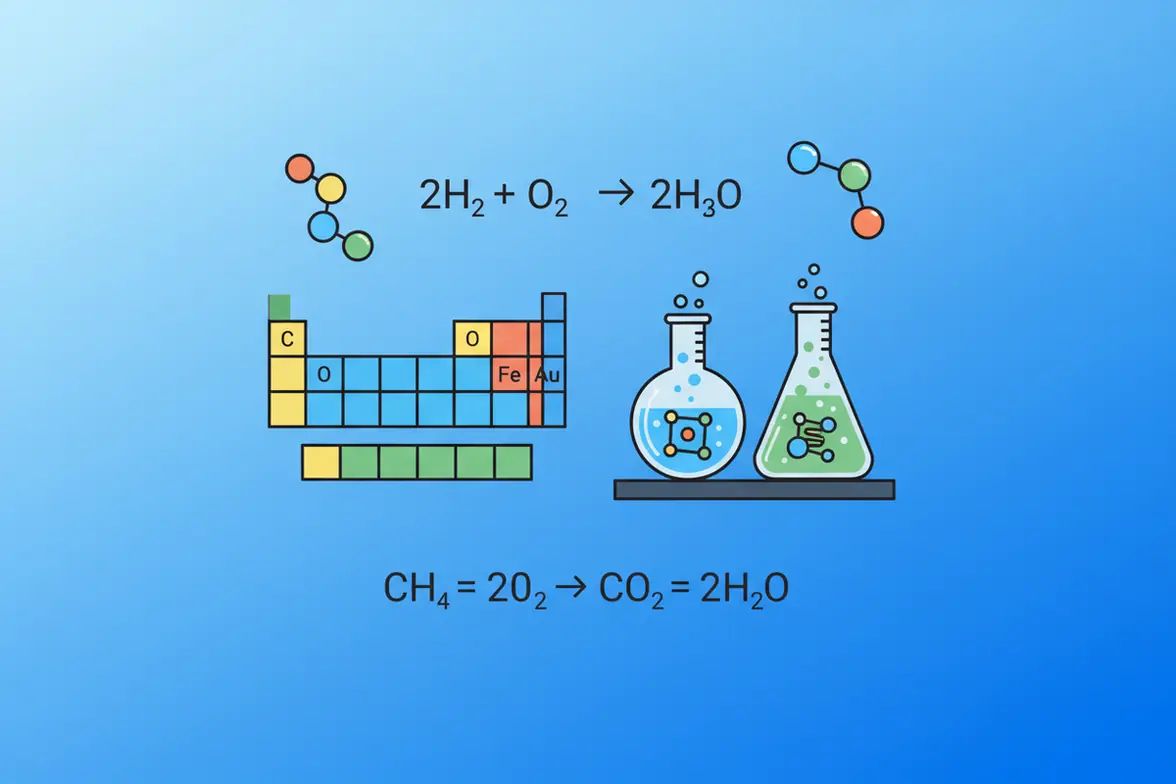
How to Use the AI Chemistry Solver
Get chemistry solutions in three simple steps.
Enter Your Chemistry Problem
Type your chemistry question, paste a chemical equation, or upload a photo of a handwritten problem. Include all given values, concentrations, and reaction conditions for the most complete solution.
AI Analyzes & Solves
The AI identifies the chemistry topic, applies the correct approach — whether it's balancing coefficients, calculating moles, or determining equilibrium — and generates a full step-by-step solution.
Review & Understand
Read through each step of the solution, follow the reasoning, and apply the same methods to similar problems in your assignment or exam preparation.
Balance Equations and Solve Stoichiometry
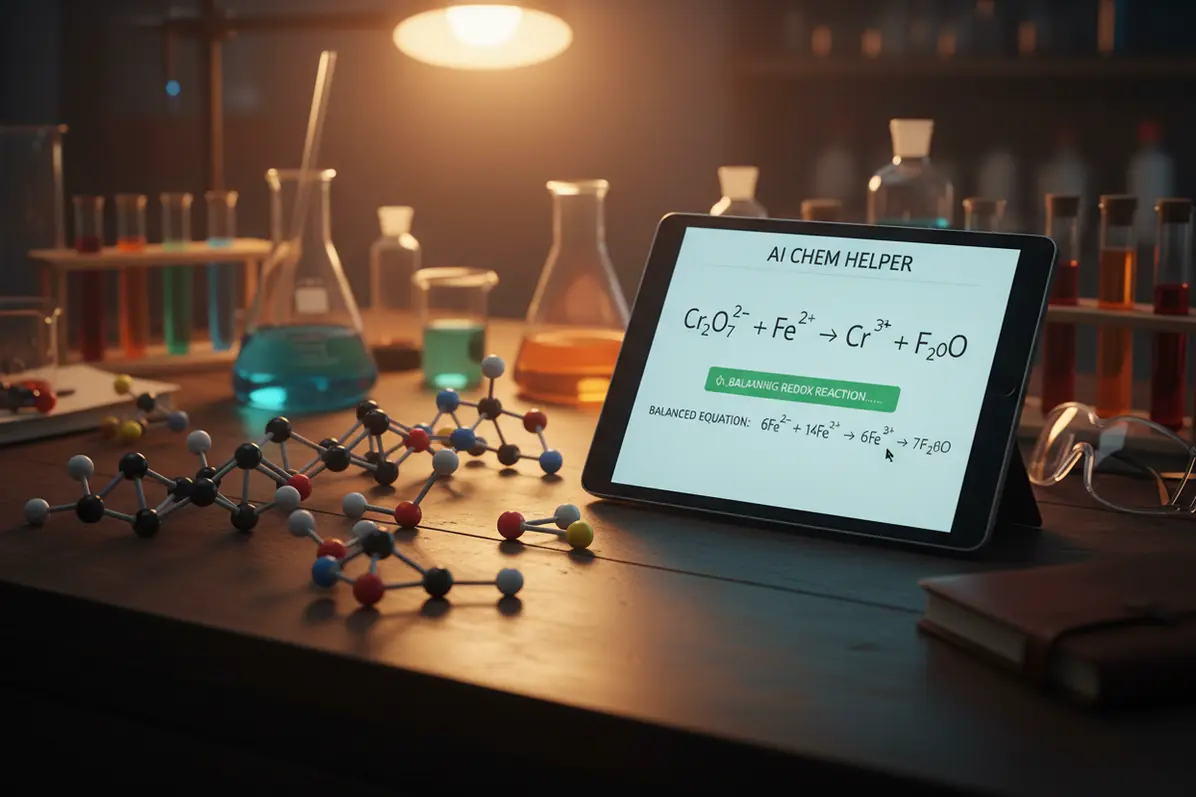
Balancing equations looks straightforward until you hit a redox reaction with six different species and half of them are polyatomic ions. The trial-and-error method from class works for simple ones, but it falls apart fast when you're dealing with permanganate in acidic solution. And stoichiometry adds its own layer — figuring out limiting reagents when you've got three reactants and aren't sure which conversion factor to use first.
The AI chem solver handles both. It balances equations systematically, showing the half-reaction method for redox problems, and walks through stoichiometry with clear mole ratios and dimensional analysis. You see exactly where each number comes from, which makes it far easier to replicate on your own the next time.
Why Chemistry Problems Need Context, Not Just Answers
A chemistry answer without context is almost useless. Knowing that the answer is 0.35 M doesn't help if you can't explain why you divided by the volume in liters instead of milliliters, or why you used the molar mass of the hydrated salt instead of the anhydrous form. Chemistry exams test the process as much as the result, and partial credit depends on showing you understand the logic.
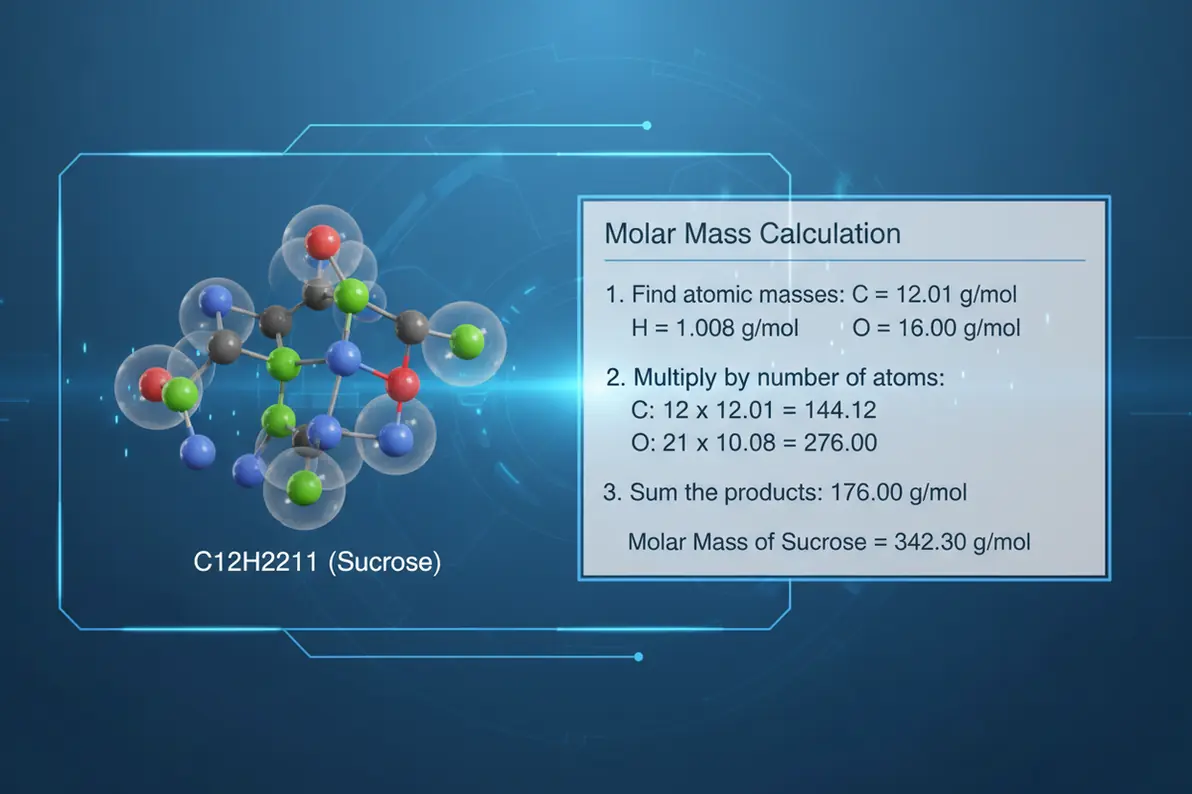
That's why the AI chemistry solver emphasizes the reasoning behind each step. When it converts grams to moles, it states the molar mass used and why. When it identifies a limiting reagent, it shows the comparison that led to that conclusion. This approach mirrors what a good TA would explain in office hours — the step-by-step reasoning that connects the given information to the final answer in a way you can reproduce independently.
Organic Chemistry and Molecular Analysis
Organic chemistry is where students either develop a strange affection for arrow-pushing or seriously reconsider their major. The sheer number of named reactions, reagents, and stereochemical outcomes can feel overwhelming. A substitution reaction might go SN1 or SN2 depending on the substrate, solvent, and nucleophile — and getting it wrong means predicting the completely wrong product.
The AI chemistry solver can walk through common organic reactions, identify functional groups, and explain why a particular mechanism is favored under given conditions. It won't replace building molecular models or practice, but it gives you a reliable check when you're not sure if that tertiary carbon really does favor elimination over substitution.
Use the Chemistry Solver for Exam Review
The most effective way to study chemistry isn't rereading notes. It's working problems until the methods become second nature. The trouble is, when you get stuck on a practice problem at home, there's no TA to ask. You can check the back of the textbook for the answer, but that doesn't tell you where your approach went wrong.
The AI chemistry solver fills that gap. Work the problem yourself first, then compare your solution step by step against the AI's. When your stoichiometry answer is off by a factor of two, you can pinpoint whether you used the wrong molar ratio or forgot to account for a diatomic molecule. That targeted feedback is more valuable than seeing a hundred worked examples passively. Active comparison builds the skills that carry into the exam room.
Gas Laws and Thermochemistry Made Simple
Gas law problems trip students up because there are multiple equations — Boyle's, Charles's, Gay-Lussac's, the combined gas law, the ideal gas law — and picking the wrong one sends the entire calculation off track. The situation gets worse when the problem involves a chemical reaction that produces or consumes gas, because now you're combining stoichiometry with gas law calculations in a multi-step problem that has no room for shortcuts.
The AI chemistry solver handles these multi-step problems by clearly separating each phase of the calculation. First it identifies the relevant gas law and explains why it applies. Then it performs the stoichiometric calculation to determine the moles of gas involved. Finally, it applies the gas law with proper unit conversions — temperature to Kelvin, volume to liters, pressure to the correct unit. Thermochemistry follows the same structured approach: identify the process, apply Hess's law or calorimetry equations, track sign conventions for endothermic and exothermic reactions, and carry units through every step. Students who struggle with these topics find that seeing the organized solution path makes the logic click in a way that textbook examples often fail to achieve. The chemistry solver treats each sub-calculation as a distinct step rather than lumping everything into one intimidating equation.
Using AI Chemistry Tools Responsibly
How NOT to Use AI Tools
- ❌ Copy balanced equations without understanding the mechanism
- ❌ Submit AI-solved chemistry homework as your own
- ❌ Skip mole calculations and unit conversions
- ❌ Ignore safety data sheets and lab procedures
- ❌ Assume AI handles all reaction conditions correctly
How to Use AI Tools Effectively
- ✅ Balance equations by hand first, then verify with AI
- ✅ Study the reaction mechanisms in each solution
- ✅ Verify stoichiometry against your textbook
- ✅ Use AI to identify gaps in your chemistry knowledge
- ✅ Treat AI as a chemistry tutor, not an answer generator
What Students Are Saying
Frequently Asked Questions
How the AI Chemistry Solver Works
Chemistry problems usually require more than plugging numbers into a formula. A good solver identifies the type of problem, tracks units, applies the right chemistry principle, and explains each step so you can learn the process.
- Enter or upload the problem: Type the question or use OCR and optical character recognition to capture a worksheet, lab question, or handwritten equation when supported.
- Identify the chemistry concept: The solver determines whether the task involves balancing equations, mole ratios, limiting reactants, gas laws, thermochemistry, acids and bases, or organic structure analysis.
- Follow step-by-step explanations: Instead of only giving the answer, HomeworkO can show worked examples that reduce cognitive load and make each calculation easier to follow.
- Check units and significant figures: Chemistry answers often depend on molar mass, liters, grams, kelvin, pressure units, and correct rounding.
- Review with active recall: Turn solved problems into flashcards, quizzes, or retrieval practice prompts to prepare for tests using spaced repetition.
- Use the answer as formative assessment: Compare the AI’s steps with your class notes to find where your understanding breaks down before a quiz or exam.
Which option fits which need
| Need | Best option |
|---|---|
| Step-by-step chemistry homework help across equations, stoichiometry, gas laws, and thermochemistry | HomeworkO for guided explanations; Wolfram Alpha is also useful for symbolic reasoning and calculation-heavy chemistry |
| Scanning printed or handwritten problems with OCR or handwriting recognition | HomeworkO for general homework capture; Photomath is stronger for math-style scanning, while Socratic can help identify science topics from images |
| Memorizing ions, solubility rules, vocabulary, formulas, and reaction types | Quizlet for flashcards and spaced repetition; HomeworkO for turning solved chemistry questions into active recall and quiz practice |
| Detailed expert-style explanations, textbook-style support, or checking complex assignments | Chegg for subscription-based expert solutions when appropriate; HomeworkO for quick learning support and step-by-step study help |
Common Chemistry Mistakes to Avoid
- Balancing equations by changing subscripts instead of coefficients, which changes the actual chemical compound.
- Skipping unit conversions, such as using Celsius instead of kelvin in gas law problems or mixing grams and moles without converting.
- Using the wrong mole ratio in stoichiometry because the balanced equation was incomplete or incorrect.
- Ignoring limiting reactants and assuming all reactants are fully used up in a reaction.
- Rounding too early, which can cause final answers to differ from the expected significant figures.
- Copying an AI answer without checking whether the reaction conditions, phase labels, charges, or school-required method match the assignment.
Limitations to know
- AI chemistry tools can make mistakes, especially with ambiguous wording, unusual reaction conditions, complex organic mechanisms, or poorly scanned images.
- OCR and handwriting recognition may misread subscripts, superscripts, charges, arrows, or decimal points, so always verify the input before trusting the solution.
- Some chemistry questions require classroom-specific assumptions, lab data, or teacher-approved methods that an AI tool may not know.
- AI should not replace learning the underlying concepts; use it to study, check reasoning, and practice rather than to submit work you do not understand.
- Follow your school’s academic integrity policy, especially for graded homework, labs, quizzes, and take-home exams.
The AI Chemistry Solver is a study tool for understanding chemistry problems through step-by-step explanations, worked examples, and review support. Use HomeworkO when you need help balancing equations, solving stoichiometry, checking gas law work, reviewing thermochemistry, or preparing with flashcards and quizzes; do not use it as a shortcut for graded work or as a replacement for your teacher’s instructions. Chemistry requires context, units, and careful reasoning, and HomeworkO helps reduce confusion while still keeping the learning process in your hands.
An AI chemistry solver uses artificial intelligence to solve chemistry problems and show step-by-step explanations. Users submit questions as text or upload images of equations and structures.
The AI identifies the chemistry topic, relevant concepts, and required calculations. It recognizes formulas and equations from text or images, then applies stoichiometry, equilibrium, or other methods to generate solutions.
Yes. It adjusts coefficients so atoms of each element are equal on both sides. Handles simple reactions, redox, and equations with polyatomic ions.
It covers stoichiometry, balancing equations, molar mass, molarity, gas laws, thermochemistry, equilibrium, acid-base, electrochemistry, and organic chemistry.
HomeworkO offers 5 free uses per day with no signup. Unlimited access is available through the HomeworkO app on iOS and Android.
Yes. The solver accepts image uploads of equations, Lewis structures, and reaction diagrams. Clear, legible images produce the best results.
Accuracy is high for standard calculations and equation balancing. Complex organic mechanisms may require verification against course materials.
Yes. It handles mole conversions, mass-to-mass calculations, limiting reagents, percent yield, and empirical and molecular formulas with full steps.
Yes. It outlines mechanisms for common reactions, showing electron movement, intermediates, and products with arrow-pushing notation.
A calculator performs specific computations from given inputs. An AI solver interprets the full problem, shows reasoning, and explains chemical principles like a tutor.