Free AI Physics Solver
Solve any physics problem instantly. Upload a photo or type your question and get step-by-step solutions for mechanics, thermodynamics, electricity, and more.
Upload an image of your physics problem
Solving your physics problem...
HomeworkO is an AI homework helper that provides step-by-step answers, writing support, flashcards, and quizzes for students. On this page, it helps students approach physics problems by explaining concepts, equations, diagrams, and reasoning in a study-friendly way.
Quick answer: An AI physics solver helps students break physics homework into understandable steps, from identifying known variables to choosing equations and checking units. HomeworkO can support mechanics, thermodynamics, circuits, waves, and other physics topics with step-by-step explanations instead of only giving a final answer.
What Is an AI Physics Solver?
An AI physics solver is a tool that uses artificial intelligence to analyze and solve physics problems across all major topics. Students submit problems as text or upload images of handwritten equations and diagrams, and the AI returns structured, step-by-step solutions. The tool covers classical mechanics, electromagnetism, thermodynamics, waves, optics, and modern physics at introductory and intermediate levels.
HomeworkO's AI physics solver uses GPT-4o-mini to interpret problems, identify relevant formulas, and generate detailed calculations with explanations. It accepts both typed questions and photographed problems. The solver shows all work including variable identification, formula selection, unit conversion, and final answers with correct units. Five free uses are available daily with no account required, and unlimited access is available through the AI Homework Helper. AI-generated physics solutions should be verified against textbook answers and course materials. The solver does not replace laboratory instruction or hands-on experimentation.
Physics Homework Help When You Need It Most
Physics problems have a way of looking simple until you're three equations deep and nothing cancels. You thought you understood free-body diagrams in lecture, but now it's 11 PM and the homework set has a pulley system with friction on an inclined plane. The textbook example conveniently skipped that case.
That's where an AI physics solver earns its keep. Paste in the problem, and you get the full breakdown — which forces act where, which equation applies, how to isolate the unknown. Not just the number, but the reasoning that connects the setup to the answer. It's the difference between memorizing a formula and understanding when to use it.
How to Use the AI Physics Solver
Get physics solutions in three simple steps.
Enter Your Physics Problem
Type your physics question directly or upload a photo of a handwritten or printed problem. Include given values, diagrams, or any constraints mentioned in the question.
AI Solves Step by Step
The AI identifies the physics topic, selects the correct formulas, performs calculations, and generates a structured solution with every step explained clearly.
Review the Solution
Read through the complete solution, check the reasoning at each step, and apply the same approach to similar problems on your assignment or exam prep.
From Kinematics to Quantum Mechanics
The physics curriculum doesn't ease you in gently. One week it's projectile motion, the next it's rotational inertia, and then suddenly you're calculating magnetic flux through a loop. Each topic has its own set of formulas, sign conventions, and common pitfalls that textbooks gloss over.
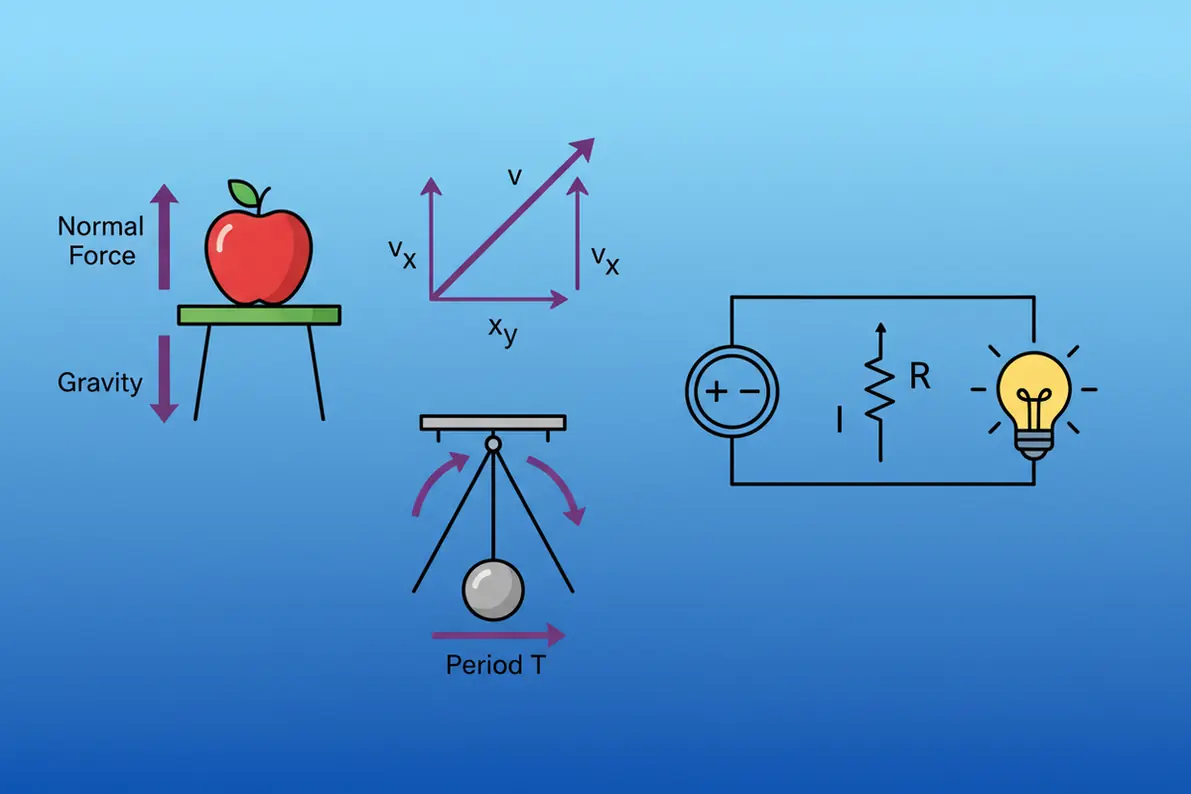
This AI physics solver handles the full range. Kinematics, Newton's laws, work-energy theorem, conservation of momentum, torque, thermodynamic cycles, Coulomb's law, Ohm's law, Faraday's law, Snell's law, wave interference — name the topic, and the solver walks you through it with the right equations and proper unit handling.

Why Physics Problems Require More Than Formulas
The hardest part of physics isn't the math. It's figuring out which math to use. Two problems can look completely different but require the same conservation law, or look identical but need entirely different approaches depending on one small detail. A block on a surface might need Newton's second law, or it might be an energy problem — and picking wrong means starting over.
The AI physics solver helps bridge that gap by showing why a particular approach was chosen, not just executing it. When you see that a collision problem uses momentum conservation because external forces are negligible during the impact, you start recognizing that pattern in other problems. That conceptual layer is what turns formula sheets into actual understanding.
Upload Physics Diagrams and Get Solutions
Half the battle in physics is interpreting the diagram. A circuit with three resistors in a combination of series and parallel. A pulley system with two masses and a frictionless surface. A lens setup with an object at some focal length multiple. These problems are visual by nature, and typing them out loses critical information.
The image upload feature lets you photograph the problem exactly as it appears. The AI reads the diagram, identifies components and values, and solves it as drawn. No need to translate a complex circuit or force diagram into text — just snap and submit. It's faster and reduces the errors that come from describing spatial problems in words.
Use the Physics Solver for Exam Preparation
Cramming formulas the night before a physics exam is a losing strategy. You end up with a head full of equations and no idea which one to pull out when the exam problem doesn't match the textbook example exactly. The real prep is working through problems until the approach becomes instinctive.
Use the AI physics solver as a practice partner. Try the problem yourself first, then check your work against the AI's solution. When your answer disagrees, compare step by step to find where you went wrong. That feedback loop — attempt, compare, correct — builds the problem-solving intuition that actually shows up on exam day. It's not about seeing more solutions. It's about understanding why each step follows from the last.
Understanding Free Body Diagrams and Force Analysis
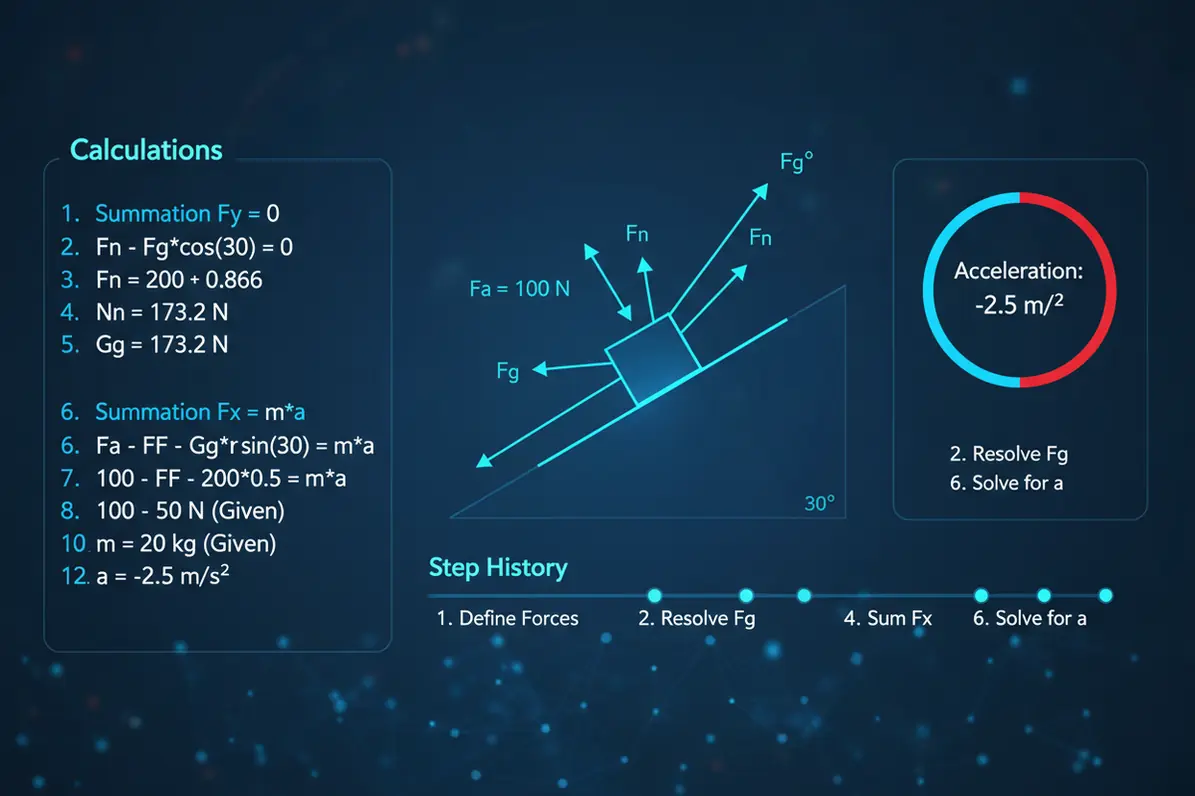
Free body diagrams are the foundation of nearly every mechanics problem, yet most students skip them or draw them incorrectly. A missing friction force, a misdrawn normal force, or a forgotten component of gravity along an incline — any of these turns the entire calculation into garbage. The AI physics solver doesn't skip this step. It starts by identifying every force acting on the object, drawing the conceptual setup, and decomposing vectors into components before writing a single equation.
That process is what separates students who understand Newtonian mechanics from those who memorize formulas and hope for the best. When you see the solver lay out the free body diagram for a block on a ramp with friction, tension, and an applied force at an angle, you understand why the x and y components are set up the way they are. The net force equation doesn't appear from thin air — it follows directly from the diagram. Practice reading these setups until you can sketch them yourself before looking at the AI's version. Once free body diagrams click, problems involving pulleys, connected masses, circular motion, and equilibrium become manageable instead of intimidating. The physics solver acts as a model for how to approach force problems systematically, building the analytical habits that carry through every topic in introductory physics coursework.
Using AI Physics Tools Responsibly
How NOT to Use AI Tools
- ❌ Copy physics solutions without understanding the concepts
- ❌ Submit AI-solved problems as your own lab work
- ❌ Skip free-body diagrams and unit analysis
- ❌ Ignore your professor's problem-solving framework
- ❌ Assume AI handles all physics edge cases correctly
How to Use AI Tools Effectively
- ✅ Attempt the problem and draw diagrams first
- ✅ Compare your approach with the AI solution
- ✅ Verify answers against your physics textbook
- ✅ Use AI to understand where your reasoning went wrong
- ✅ Treat AI as a physics study partner, not an answer sheet
What Students Are Saying
Frequently Asked Questions
How to Use the AI Physics Solver
Physics problems are easier when you slow down the setup: read the situation, list the knowns, identify what is being asked, then connect the concept to the correct equation or principle. An AI physics solver can act like a worked-example guide that reduces cognitive load while still helping you practice the reasoning.
- Enter or upload the problem, including units, diagrams, given values, and what the question asks for.
- Use OCR, optical character recognition, and handwriting recognition when available to capture printed or handwritten physics questions more quickly.
- Review the step-by-step explanations to see how the solver chooses formulas, substitutes values, and checks dimensions.
- Ask follow-up questions such as why a force is positive, when acceleration is constant, or how Kirchhoff’s laws apply in a circuit.
- Turn solved problems into flashcards or quizzes for active recall, spaced repetition, retrieval practice, and formative assessment before a test.
- Compare the AI’s reasoning with your class notes, textbook method, or teacher’s preferred notation to support academic integrity.
Which option fits which need
| Need | Best option |
|---|---|
| Step-by-step physics homework help across mechanics, thermodynamics, circuits, and diagrams | HomeworkO |
| Symbolic reasoning, algebraic manipulation, unit-aware calculations, and advanced equation solving | Wolfram Alpha |
| Fast camera-based help for printed homework questions and general explanations | Socratic |
| Physics exam review through flashcards, active recall, and spaced repetition | Quizlet |
Common Physics Solver Mistakes to Avoid
- Copying the final answer without understanding the model, assumptions, or why a specific equation applies.
- Ignoring units, signs, vectors, and coordinate directions, especially in force, motion, and electric field problems.
- Using a formula before checking whether its conditions are valid, such as constant acceleration or no energy loss.
- Reading diagrams too quickly and missing labels, angles, contact forces, or circuit connections.
- Treating AI output as automatically correct instead of verifying the answer with estimation, dimensional analysis, or class examples.
- Skipping conceptual practice; higher levels of Bloom’s taxonomy require explaining, applying, and evaluating, not just calculating.
Limitations to know
- AI physics tools can make mistakes with diagrams, ambiguous wording, unusual notation, or multi-step symbolic reasoning.
- OCR and handwriting recognition may misread subscripts, exponents, Greek letters, units, or circuit labels, so students should check the input carefully.
- Some schools restrict AI use on homework, labs, quizzes, or take-home exams; always follow your teacher’s academic integrity policy.
- Physics often depends on assumptions such as frictionless surfaces, ideal gases, or negligible air resistance, and the solver may need those stated clearly.
- AI help is most useful for learning and checking reasoning, not for replacing labs, teacher feedback, or independent problem solving.
A free AI physics solver can help students understand homework by turning problems into clear steps, explaining formulas, diagrams, units, and concepts along the way. Use HomeworkO when you are stuck on setup, need a worked example, want to check your reasoning, or are preparing for exams with quizzes and flashcards. Do not use it to bypass learning, violate school rules, or submit answers you cannot explain; use it as a study partner that supports practice, verification, and deeper understanding.
An AI physics solver uses artificial intelligence to solve physics problems and show step-by-step explanations. Users input problems as text or upload images.
The AI analyzes the problem, identifies relevant concepts and formulas, and generates a structured solution. It handles text and image uploads, applies equations, and explains each step.
It covers mechanics, kinematics, dynamics, thermodynamics, electrostatics, circuits, magnetism, waves, optics, and modern physics. Handles introductory through advanced undergraduate level.
Yes. It provides complete step-by-step solutions with variable identification, formula selection, calculations, and final answers with correct units.
HomeworkO offers 5 free uses per day with no signup. Unlimited access is available through the HomeworkO app on iOS and Android.
Yes. The solver accepts image uploads of handwritten or printed problems. Clear, well-lit photos produce the best results.
Accuracy is high for standard problems with known formulas. Complex or multi-step problems may need verification against course materials.
Yes. It extracts given values, identifies what is asked, selects the correct approach, and translates the description into mathematical form.
Yes. It identifies when conversions are needed, performs them, and presents answers in appropriate SI or requested units.
A calculator computes from a specific formula. An AI solver interprets the full problem, selects the approach, shows reasoning, and explains each step like a tutor.