Free AI Calculus Solver
Solve derivatives, integrals, limits, and more with step-by-step explanations. Type your calculus problem or upload a photo and get the full solution instantly.
Upload an image of your calculus problem
Solving your calculus problem...
HomeworkO is an AI homework helper that provides step-by-step answers, writing support, flashcards, and quizzes for students. On this page, it focuses on calculus support for derivatives, integrals, limits, series, and real-world application problems.
Quick answer: An AI calculus solver helps you solve derivatives, integrals, limits, series, and related problems with step-by-step explanations instead of just a final answer. HomeworkO lets students type a calculus problem or upload a photo, then review the reasoning so they can check work, study worked examples, and prepare for quizzes without needing an account.
What Is an AI Calculus Solver?
An AI calculus solver is a tool that uses artificial intelligence to solve calculus problems and provide step-by-step explanations. It processes derivatives, integrals, limits, series, and differential equations by interpreting the mathematical notation and applying the correct solving techniques. Users submit problems as typed text or uploaded images, and the AI generates a structured solution that shows each step of the process. AI calculus solvers are used by students in Calculus I, II, and III courses as study aids and homework tools.
HomeworkO's free AI calculus solver runs in the browser with no signup required. It accepts typed problems and photos of handwritten calculus work. The tool uses GPT-4o-mini to identify the problem type — derivative, integral, limit, or application problem — and generates a step-by-step solution with explanations for each operation. The solver handles the power rule, chain rule, product rule, quotient rule, u-substitution, integration by parts, partial fractions, L'Hôpital's rule, and more. HomeworkO provides 5 free uses per day, with unlimited access through the AI Homework Helper on iOS and Android. AI-generated calculus solutions should be verified against course materials. The tool does not replace instruction from qualified mathematics professors.
Calculus Help When You Actually Need It
Calculus has a way of making smart students feel dumb. You understood algebra fine. Trig was manageable. Then derivatives hit, and suddenly the notation alone is overwhelming. The textbook explanation assumes you already get it. The professor moved on two lectures ago. And the homework is due at midnight.
That's the exact moment HomeworkO's calculus solver was built for. Type in the problem — or photograph it from your notebook — and get a clear, step-by-step walkthrough. Not just "the answer is 4x³." The full chain of reasoning: identify the rule, apply it, simplify, check. The kind of calculus help that makes the next problem easier, not just this one.
It works for derivatives, integrals, limits, series, and application problems. Every step is explained in plain language alongside the mathematical notation.
How to Use the AI Calculus Solver
Get your calculus solution in three steps.
Enter Your Calculus Problem
Type your derivative, integral, limit, or other calculus problem into the text box. You can also upload a photo of a handwritten or printed problem from your textbook or notes.
AI Identifies & Solves
The AI identifies the problem type, determines the appropriate calculus technique (chain rule, u-substitution, integration by parts, etc.), and works through each step of the solution.
Review & Learn the Method
Read through each step of the solution and the explanation behind it. Understanding the method lets you apply the same technique to similar calculus homework problems on your own.
Derivative Solver with Full Explanations
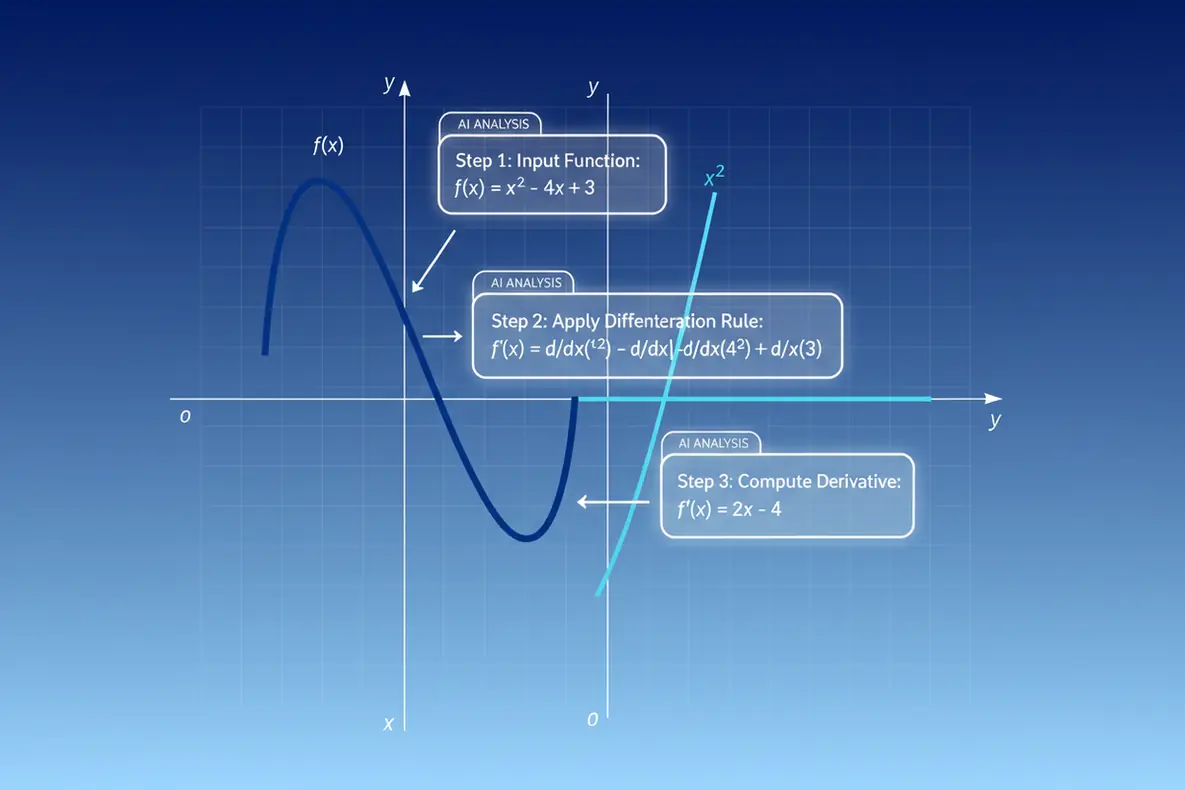
Derivatives are usually the first major hurdle in calculus. Power rule seems simple enough, then the chain rule shows up and suddenly you're differentiating nested functions three layers deep. Product rule and quotient rule add more complexity. Implicit differentiation feels like it breaks all the rules you just learned.
The AI derivative solver handles all of it. Type in f(x) = (3x² + 1)⁵ and you'll see the chain rule applied with the outer and inner functions clearly identified. Each differentiation step is shown and explained. For implicit differentiation, the solver tracks dy/dx through every term. You see the mechanics, not just the result.
Integral Calculator with Step-by-Step Work
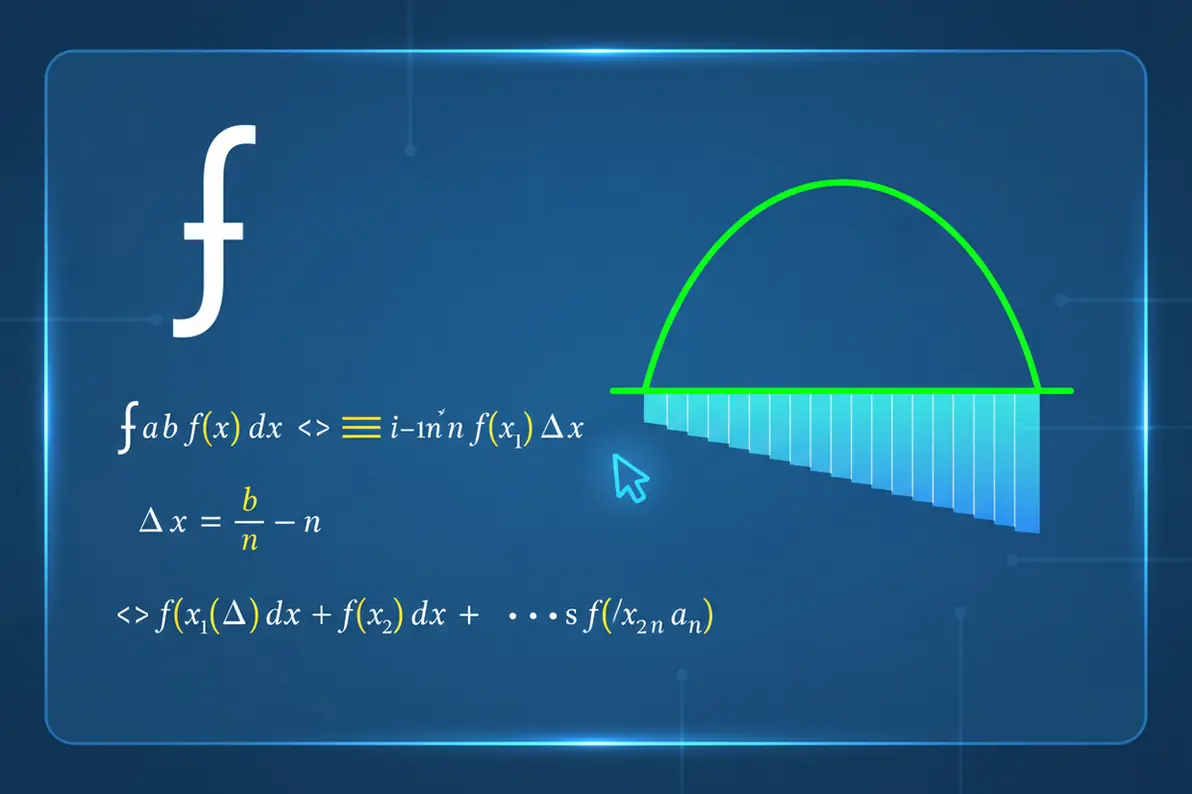
Integration is where calculus students spend the most time struggling. Unlike differentiation, there's no single algorithm that works every time. You have to recognize patterns and choose the right technique — basic antiderivatives, u-substitution, integration by parts, trig substitution, partial fractions. Picking the wrong approach means wasted time and a dead end.
HomeworkO's integral calculator identifies the best integration method for each problem and walks you through it. If the integral calls for u-substitution, the solver shows the substitution, the transformed integral, the solution, and the back-substitution. For integration by parts, you see the choice of u and dv, the application of the formula, and the simplification. The AI handles both definite and indefinite integrals, including evaluation at bounds for definite integrals. It's calculus homework help that teaches you to recognize which technique to use next time.
Limits, Series, and Beyond
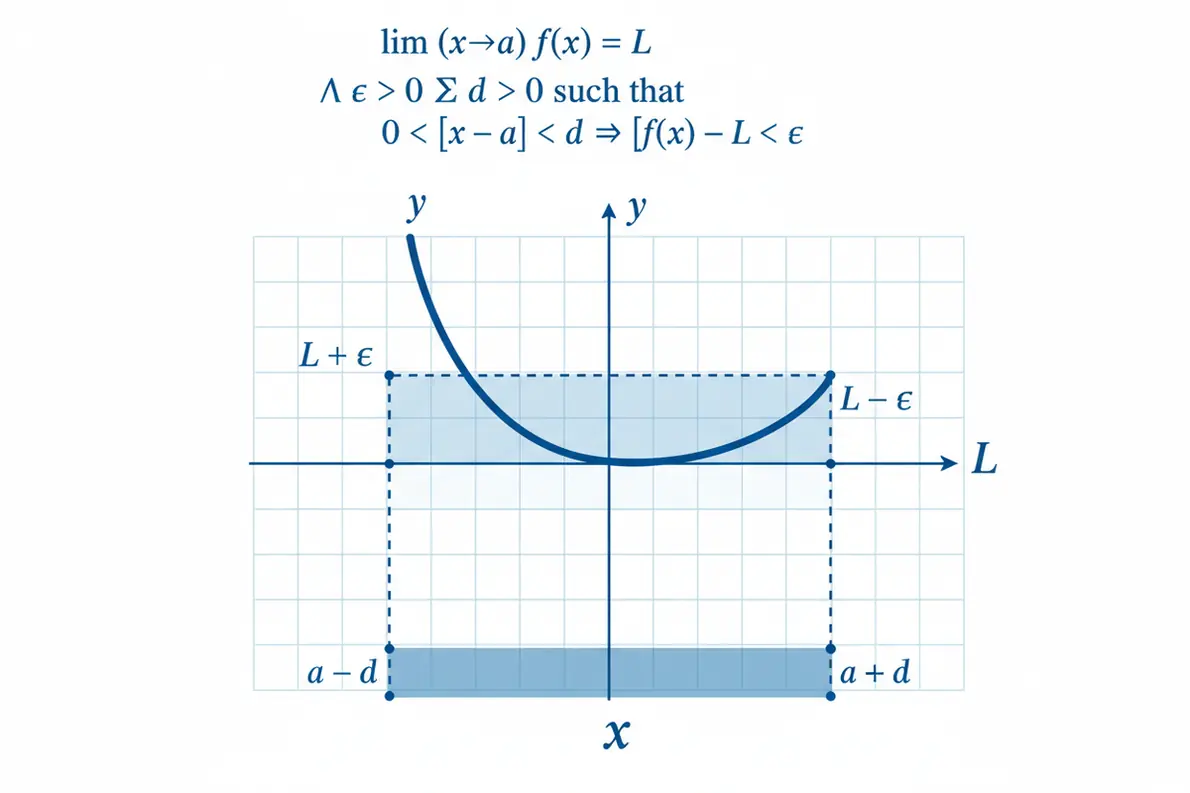
Limits are the foundation that the rest of calculus is built on, but they come with their own set of headaches. Indeterminate forms. L'Hôpital's rule. Squeeze theorem. Epsilon-delta proofs if your professor is feeling ambitious. Each one requires a different approach, and knowing which tool to reach for is half the battle.
The AI calculus solver evaluates limits using direct substitution, factoring, rationalization, and L'Hôpital's rule. It recognizes indeterminate forms and applies the correct resolution strategy. For series and sequences, the solver handles convergence tests, partial sums, and Taylor/Maclaurin expansions. Every step includes the reasoning behind the technique selection, so you learn the decision-making process alongside the computation.
Real-World Applications of Calculus Concepts
Calculus homework feels abstract until you see where it shows up in the real world. Derivatives describe rates of change — velocity, acceleration, marginal cost, population growth rates. Integrals calculate accumulated quantities — distance traveled, area under a curve, total revenue, probability distributions. Differential equations model everything from radioactive decay to compound interest to the spread of diseases through populations.
The AI calculus solver doesn't just produce a numerical answer. When you solve an optimization problem about minimizing the surface area of a container, the solver explains why setting the derivative equal to zero finds the minimum. When you evaluate a definite integral representing the area between two curves, the explanation covers why subtraction of the lower function from the upper one gives the correct region. These contextual explanations help students connect the mechanical process of differentiation and integration to the meaning behind the computation. Engineering students working with related rates, economics students analyzing marginal functions, and physics students solving kinematics problems all benefit from seeing how the same calculus techniques apply across disciplines. Understanding the application makes the technique memorable and the homework meaningful rather than purely procedural.
Using AI Calculus Tools Responsibly
How NOT to Use AI Tools
- ❌ Copy derivative/integral solutions without understanding them
- ❌ Submit AI-solved calculus homework as your own
- ❌ Skip the fundamental theorem explanations
- ❌ Ignore your professor's preferred notation
- ❌ Assume complex integrals are always computed correctly
How to Use AI Tools Effectively
- ✅ Work through limits and derivatives by hand first
- ✅ Study the chain rule and substitution steps
- ✅ Verify answers with your calculus textbook
- ✅ Use AI to identify where your technique fails
- ✅ Treat AI as a calculus tutor, not an answer machine
What Students Are Saying
Frequently Asked Questions
How the AI Calculus Solver Works
Calculus often becomes easier when each transformation is explained clearly. An AI calculus solver can reduce cognitive load by breaking a problem into smaller steps, but students should still compare the reasoning with class methods and practice independently.
- Type the problem or upload a photo; OCR, also called optical character recognition, helps read printed or handwritten math when the image is clear.
- The solver identifies the topic, such as a derivative, integral, limit, series, optimization problem, or related rate problem.
- Step-by-step explanations show the rule being used, such as the product rule, chain rule, substitution, integration by parts, or L'Hopital's Rule when appropriate.
- Worked examples help students move from recognizing a method to applying it, which supports higher levels of Bloom's taxonomy like analysis and problem solving.
- Students can turn missed problems into flashcards or quiz questions to use active recall, spaced repetition, and retrieval practice before an exam.
Which option fits which need
| Need | Best option |
|---|---|
| Step-by-step calculus help with typed or photo-uploaded problems, plus study tools for review | HomeworkO |
| Fast camera-based math recognition for common textbook-style problems and arithmetic-to-calculus support | Photomath |
| Advanced symbolic reasoning, graphing, exact forms, and technical computation for higher-level math | Wolfram Alpha |
| General homework explanations, concept search, and course-style support, with flashcards or expert help when needed | Socratic, Quizlet, or Chegg depending on the task |
Common Calculus Mistakes to Watch For
- Forgetting the chain rule when differentiating a composite function, such as sin(3x) or e^(x^2).
- Dropping the constant of integration after finding an indefinite integral.
- Using algebraic cancellation incorrectly before evaluating a limit.
- Choosing substitution or integration by parts without checking whether the expression actually fits the method.
- Relying on a final AI answer without checking domain restrictions, units, endpoints, or whether the result makes sense in context.
- Copying steps without understanding them, which can violate academic integrity rules and makes tests harder.
Limitations to know
- AI can misread messy handwriting, unusual notation, or low-quality photos, even with handwriting recognition.
- Some calculus problems have multiple valid solution methods, and the AI's method may not match the one your teacher expects.
- Symbolic answers may need simplification, domain checks, or numerical verification.
- Word problems can be misunderstood if the variables, units, or constraints are unclear.
- Students should follow their school's academic integrity policy and use AI as formative assessment and study support, not as a substitute for their own work.
A free AI calculus solver is most useful when you need a clear worked example for derivatives, integrals, limits, series, or application problems and want to understand the steps before practicing on your own. It should not replace class notes, teacher instructions, or independent test preparation. HomeworkO helps by combining photo or typed problem solving with step-by-step explanations and study tools like flashcards and quizzes so students can learn from mistakes and build stronger calculus skills.
An AI calculus solver uses artificial intelligence to solve calculus problems and generate step-by-step explanations. It handles derivatives, integrals, limits, series, and differential equations.
The solver handles derivatives, definite and indefinite integrals, limits, series, differential equations, related rates, and optimization. It covers Calculus I through III.
Type your problem into the text box or upload a photo. Click solve and the AI identifies the problem type and generates a step-by-step solution. No signup required.
HomeworkO provides 5 free uses per day with no signup required. Unlimited calculus solving is available through the HomeworkO app on iOS and Android.
Yes. The solver shows every step of differentiation, including which rules apply and how each term is handled. The format mirrors textbook or instructor style.
Yes. The solver generates step-by-step solutions for definite and indefinite integrals. It identifies the right technique and shows each step of the process.
Accuracy is highest for well-formed problems with clear notation. Complex or non-standard problems may occasionally produce errors. Verify results against course materials.
Yes. The solver accepts photos of handwritten or printed calculus problems. Clear photos with legible notation produce the best results.
Yes. It provides step-by-step solutions for derivatives, integrals, limits, and applications. Use solutions to learn methods, not to copy answers.
A graphing calculator computes and plots but does not explain. An AI solver interprets the problem, solves symbolically, and provides step-by-step reasoning.